
3D Shape Marks: A 360-Degree Analysis
1. Introduction
In this piece, I conduct a 360-degree analysis of shape trade marks in Europe. I consider which marks are being filed at the European Union Intellectual Property Office (EUIPO), which are being registered, and why they are being registered or refused registration. I then consider the lessons to learn about how we approach shape marks, including whether it is functionality or distinctiveness that is the bulwark against the over-extension of shape mark protection under EU trade mark law, and identifying serious competitive concerns raised by the EUIPO’s approach to shape marks. I begin with an introduction explaining how shape marks can interfere with fair competition and why consumers may not view shapes as trade marks anyway—getting that balance right is the reason this research matters.
A. Background
(i) Some shape mark-specific issues
Once upon a time, a mark consisting of the shape of goods or the shape of packaging could, in many jurisdictions, not be registered as a trade mark.[1] However, following EU harmonisation of trade mark law, all types of marks became open to registration, including shape marks.[2] However, shape marks pose a number of challenges, both in terms of how they are perceived by consumers and their impact on competition.
First and foremost, registration of a mark consisting of the shape of goods could place control over certain product characteristics into the hands of a single undertaking. This is problematic because if competitors are barred access to those protected product characteristics, they may be unable to produce goods that can compete effectively with the trade mark owner’s. For example, in an early case, Philips[3] attempted to defend its shape mark protecting the triangular arrangement of three rotatable shaving heads. While there were other ways to arrange the cutting blades, had the registration been upheld, Philips would have been able to prevent competitors from producing one of the more efficient configurations.
Secondly, product and packaging shapes are often eligible for other forms of intellectual property protection (IPR). Product shapes are the traditional subject matter of registered and unregistered design and copyright protection, while technical aspects of shape fall within the realm of patent protection. Trade marks are of potentially unlimited duration,[4] whereas other IPRs are time-limited for good reason. If a trade mark is granted in respect of matter that has already benefitted from another IPR, this could effectively extend the term of the original protection and prevent that subject matter from entering the public domain. This is potentially bad for competitors and consumers alike and seems to undermine the balance that the legislature sought by setting a fixed term of protection.[5] Some businesses may bypass the other IPRs (with their limits and exclusions) altogether and opt to only obtain trade mark rights.
Finally, consumers may understand that the primary ‘meaning’ of a product’s shape is what type of product it is, what its qualities are and/or how the product works. Consumers may simply not perceive the shape of goods or packaging as communicating any message about trade origin: consumers may see the shape as an integral aspect of the goods, and not as a trade mark.
(ii) Shape marks—the law
EU trade mark law has responded to these special challenges pertaining to shape marks. Art. 7(1)(b) European Trade Mark Regulation (EUTMR) states that a mark cannot be registered if it is devoid of distinctive character. In acknowledgement of the fact that consumers do not generally recognise shapes as being indicative of origin, the Court of Justice of the European Union (CJEU) has adumbrated what is arguably a stricter regime for shape marks than other forms of mark. Ordinarily, a mark need only have a minimal level of distinctiveness to satisfy Art.7(1)(b).[6] However, in Henkel, the CJEU set the bar higher for shape marks by stating that for a shape to be distinctive it must depart significantly from the norms in the sector concerned. The Court denies that this is a stricter test, but rather recognises the reality of consumer shape perception.[7]
Additionally, the threat to competition posed by shape marks was specifically acknowledged during the drafting of the harmonising legislation by specifically excluding marks which are necessary to obtain a technical result (technical functionality), marks which add substantial value (including aesthetic marks) to the goods, and basic/generic shapes which ‘result from the nature of the goods’.[8] The CJEU has sometimes opined that these ‘functionality’ provisions also exist to deal with the challenge posed by overlapping IP rights.[9]
Since Art.7(1)(b) is justified by consumer perception, if it can be shown that consumers have learned to recognise an otherwise non-distinctive mark as indicative of origin through use, the mark can be registered based on acquired (as opposed to inherent) distinctiveness. However, because Art.7(1)(e) is justified by protecting the interests of competitors, it cannot be overcome by showing acquired distinctiveness.
(iii) Shape marks—academic orthodoxy
Given these special standards, and in particular the strictness of the distinctiveness test, scholars have understandably assumed that it is almost impossible to register a shape mark in Europe based on inherent distinctiveness. For example, Senftleben[10] argues:
the shape of products or their packaging … are likely to be found devoid of distinctive character in the EU. Trademark rights can only be obtained by showing that distinctive character has been acquired through use in trade.
Likewise, Kur sees those shape marks that are registered as exceptional, opining that:
It remains a mystery how it shall be possible in practice to sort out those different layers [of distinctiveness and functionality] and establish appropriate and feasible criteria to identify the ‘champions’ in this contest, i.e., those lucky shapes that are neither too plain nor too splendid to be accorded inherent distinctiveness.[11]
This position is understandable, given that the CJEU’s Henkel distinctiveness standard formulated appears to be significantly more stringent that applied to European Union Trade Marks (EUTMs) generally. Moreover, the functionality provisions would, on their face, appear to be designed to exclude a range of shapes from registration. However, in this piece I argue that an empirical study of shape marks filed at EUIPO demonstrates that these academic assumptions do not reflect the reality. In fact, a significant number of shape marks are registered as EUTMs, and based on inherent, rather than acquired, distinctiveness.
B. Research Aims
Before embarking on this research, I had previously conducted research on functionality[12] and undertaken an empirical study of grounds for refusal of shape mark applications.[13] While completing that research, I realised that shape marks were being registered, suggesting that registration might be easier that the academic orthodoxy indicated, at the EUIPO at least. This motivated me to identify which shape marks were being filed as EUTMs, trace the outcome of those applications, and see if it was possible to identify particular characteristics which contributed higher/lower rates of acceptance. For example, as I was familiar with shape registrations covering packaging, I wanted to investigate whether registration was possible for product shapes too. When I completed my previous shape mark research, I noted how few registrations seemed to rely upon acquired distinctiveness, so I was interested to investigate Senftleben’s suggestion that shape marks were required to have acquired a distinctive character. Finally, when previously reviewing EUIPO functionality decisions, I had noticed that they frequently also included a ruling on distinctiveness. Indeed, some cases although returned in a search for the functionality provisions, merely cited them without discussion, with the decision instead focussing solely on distinctiveness. Thus, I wanted to investigate the extent to which functionality has an independent role in the examination of shape marks. Answering this question seemed particularly important given the supposed role that functionality plays in preventing registration of shape marks which might hinder fair competition.
C. Existing Literature
There is a growing body of work employing empirical methodology to critique trade mark law. Some have analysed trade mark jurisprudence, for example Beebe’s work tracking the factors used for finding confusion in the USA[14] and my analysis of the confusion factors in the EU.[15] Cornwell has considered underlying modes of reasoning in the CJEU’s trade mark jurisprudence.[16] Others have focussed on which marks are being registered, often with a view to assessing register clutter and congestion, e.g. Beebe and Fromer[17] and von Graeventiz.[18] Closest to this project are those that adopt an empirical perspective to consider non-traditional marks. Castaldi focusses on registration of non-traditional marks before the US Patent and Trademark Office (USPTO).[19] Adams and Scaramaglia consider a range of jurisdictions, including the EU, analysing which types of mark are registered, but without detailed consideration of why individual marks are (not) registered.[20] Finally, there is my empirical analysis of grounds for refusal of shape marks.[21]
This research goes further, because the focus is on both why marks are refused, and also why marks are registered, and on whether particular mark characteristics makes marks more, or less, likely to be registered. Unlike Adams and Scaramaglia, I look not only at general trends, but also in detail at the reasons why individual marks were refused registration. From this build up a picture of general trends as to which ground for refusal is most influential at EUIPO.
2. Methodology
I used the EUIPO e-Search Plus database[22] to search for all marks classified as ‘3D shape’ with a filing date between 1 January 2017 and 31 December 2021. This 5-year period was chosen because, while recent, it also left enough of an interval to ensure that the EUIPO would have reached registration decisions in most cases. As the applicant is responsible for selecting the mark type, the study includes some atypical shape marks, such as shaded logos (discussed in Section 3.B, below). However, the author decided not to go behind the mark characterisation on the database, since the EUIPO would treat these as 3D marks. Equally, as identified by Gangjee,[23] there are 3D marks on the register that the applicants have categorised as, e.g., figurative marks, which will not appear in the search results collected from the EUIPO database. This classification phenomenon makes it difficult to identify the entire scope of 3D marks protected as EUTMs, without requiring a visual inspection of all figurative marks filed within the 5-year period covered by the study.[24]
The search identified that 2,024 ‘3D shape’ applications were filed during the 5-year period. Of these, a number were registered for only some of the original goods/services specified and rejected for others. While these simply appear on the database as ‘registered’, to capture the history more accurately, I recorded the classes which had been registered classes, and then established a second entry denoted with the same number but with a ‘B’ suffix—which I termed a ‘partial refusal’—for those goods/services which had been refused. Consequently, there are 2,137 entries in the data set as certain marks appear twice—once as a registered mark and once as a partial refusal. In analysis which considers the mark types filed, the data set of 2,024 marks has been used, whereas the larger data set has been used when considering reasons for refusal. The status information is correct as of 31 May 2022, but this may have changed subsequently, since an application which was then awaiting examination might have been registered, rejected, withdrawn, etc., since.
3. Results I: Which Shape Marks Were Filed? Which Were Registered? In Which Classes?
The next two sections examine the type of shape marks which were filed during the 5-year period and whether successful registration was influenced either by the nature of the mark or the goods for which protection was being sought. This section covers the mark types being filed and registered, while Section 4 examines the reasons why those marks are registered or rejected.
A. How Many Shape Marks Were Filed?
During the 5-year period of the study, 2,024 marks[25] characterised as ‘3D shape’ were filed at the EUIPO. Of these, 72% (n.1,462) were registered[26] and 15% (n.310) of applications were refused. The remaining applications were either pending, had been withdrawn, or had been registered, but then cancelled or surrendered. We can contrast this with the outcome of all applications filed at the EUIPO (all mark types) during the same 5-year period shown in Table 1: of the 674,896 applications filed, 90% were registered while only 4% (n.26,081) were refused registration.
Table 1.
Application Refusals and Registrations by Mark Type
|
. |
3D Shape Marks. |
All EUTMs. |
|---|---|---|
|
Applications |
2,024 |
674,885 |
|
Registration |
1,462 (72%) |
610,399 (90%) |
|
Refusals |
310 (15%) |
26,081 (4%) |
|
. |
3D Shape Marks. |
All EUTMs. |
|
Applications |
2,024 |
674,885 |
|
Registration |
1,462 (72%) |
610,399 (90%) |
|
Refusals |
310 (15%) |
26,081 (4%) |
Although shape marks account for just 0.2% of marks registered at EUIPO during the relevant period, we can see that it is certainly not ‘impossible’ to register shape mark. Moreover, most shape mark applications filed proceeded to registration. We shall consider the basis on which these shape marks were accepted in more depth later.
It is worthing noting, however, that shape marks are less likely to proceed to registration than other forms of mark. This is not just because shape marks are more likely to be refused than mark forms (15% refusal for shape marks compared to 4% of refusals for all mark forms), but also that the withdrawal rate for shape marks is 3% higher than that for all marks. Applicants typically withdraw an application when it faces an objection which is unlikely to be resolved, thereby pre-empting a formal ‘refusal’ decision.
B. Which Types of Shape Marks Are Being Filed?
The EUIPO does not sub-categorise shape marks beyond the basic ‘3D shape’ category. However, I sought to classify them with further granularity to determine what might be contributing to an application’s acceptance or rejection. Through examining the types of marks that were filed, I identified five types of 3D marks, three of which are discussed in more detail below, viz:
- Product (mark depicts the shape of the goods for which registration was sought)
- Packaging
- Logo
- Services
- Other.
The results are summarised in Chart 1, which details the number of each type of mark applied for and registered as a 3D shape mark.
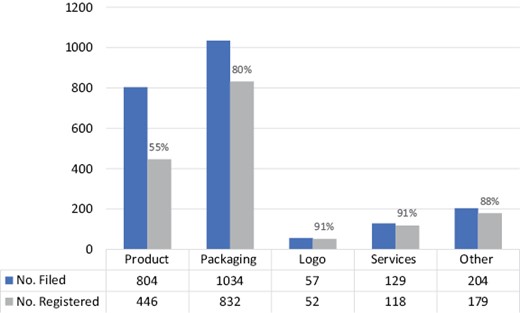
Types of Shape Marks—Filed and Registered.
Of the various types of shape marks, more including an application for packaging shapes (51% of the 2,024 filings for 3D shape marks) than for product shapes (40% of filings). Perhaps more surprising is that ‘Other’ forms of 3D marks comprise a small but significant (10%) percentage of the total number of 3D shape filings. Such marks do not appear to be envisaged by the EUIPO Trade Mark Examination Guidelines (‘EUIPO Guidelines’) which define shape marks thus:
A shape mark is a mark consisting of, or extending to, a three-dimensional shape, including containers, packaging, the product itself or its appearance. The term ‘extending to’ means that shape marks cover not only shapes per se, but also shapes that contain other elements, such as word elements, figurative elements, or labels.[27]
(i) Logos
Logos represents 3% of 3D shape marks filed. Many of these include shading which give the logo a 3D effect, such as EUTM No. 018232318 illustrated in Figure 1.

EUTM No. 018232318.
It is difficult to see any harm resulting from what is a questionable characterisation of such 2D marks as ‘3D shapes’, however, as the numbers indicate that this is more than an occasional isolated error, then perhaps there is scope for greater clarity in the EUIPO filing guidance.
(ii) Services
A significant minority, 6% (n.129), of shape marks were filed designating services.[28] In some cases, the mark depicted the shape of a product used to provide the service designated. This is a cause for concern because, on its face at least, the wording used appears to limit the functionality exclusions to the shape marks that cover goods, making no mention of services.[29] Indeed, both the European Free Trade Association (EFTA) Court[30] and the EUIPO Guidelines[31] suggest that Art.7(1)(e) does not apply to services. Yet arguably the same competition concerns may apply when product shapes are registered for both goods and services.
For example, EUTM No. 017450586, shown in Figure 2 and depicting a hut, has been registered for ‘temporary accommodation’ services. This registration could be enforced to prevent competitors from using temporary buildings of the type embodied by the mark to offer ‘glamping’ services, even though consumers may want to access such services from a range of competitive suppliers.
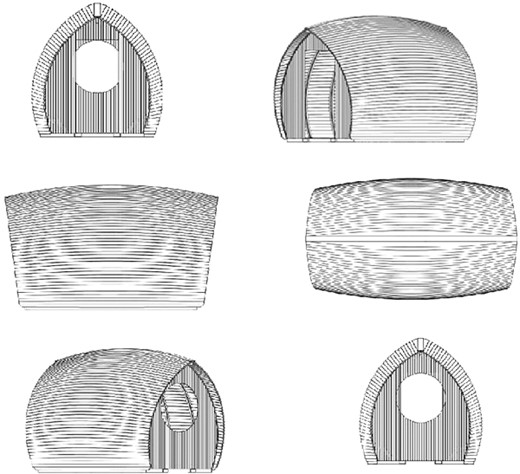
EUTM No. 017450586.
Likewise, Figure 3 shows EUTM No. 015979776, which depicts a cappuccino in an ice cream cone.[32] This application was refused for ‘coffees and prepared coffee beverages’ but was registered for ‘coffee shop services’. This registration could limit the menu of drinks offered by competing cafés. Similarly, Figure 4, shows EUTM No. 16378309, depicting the shape of a vehicle (a model made by Land Rover) registered for ‘vehicle repair services’.[33] This registration could be used to prevent third parties offering vehicle repair services using an image of this vehicle[34] in their marketing materials.
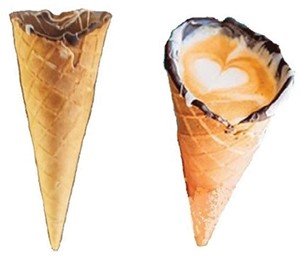
EUTM No. 015979776.

EUTM No. 016378309.
(iii) Other
The subcategory of ‘Other’ was adopted to refer to the shape marks that did not fall within one of the earlier-discussed categories. These marks, accounting for 10.1% (n.204) of the shape marks filed, includes mascots, avatars for use in computer games and layouts of shops and cafes,[35] which should not raise competition issues. However, this category also includes 121 applications (over 5% of the total shape marks filed) for shapes which are the shape of products, but which cover other goods, i.e. not the goods that the mark depicts. Of these, 97 (80%) proceeded to registration. Yet such registrations frequently do raise competition concerns. In a number of these cases, the applicant was refused registration in respect of the goods embodied in the mark but was successful in relation to closely related goods. This means that these registrations might be infringed by third-party use of the product shape for the goods that have been refused protection.
For example, EUTM No. 018138964, for the shape of a car depicted in Figure 5, was refused registration for ‘motor vehicle’ and various toys including ‘remote-controlled cars’ yet was registered for other types of toys. The risk is that in the future, the proprietor will argue that third-party use on ‘remote-controlled cars’ is confusingly similar to the other toys still covered by the registration.
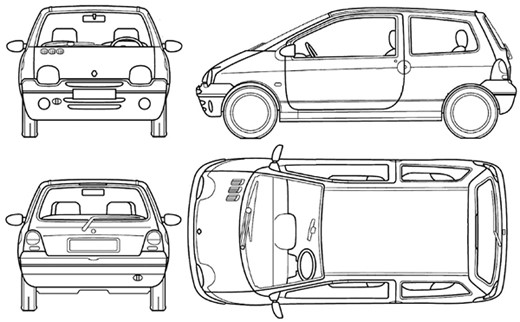
EUTM No. 018138964.
Similarly, EUTM No. 018126468, depicted in Figure 6, was refused for ‘baby bottles’ but still registered for ‘beverages’ and ‘packaging’. Arguably, ‘beverages’ are complimentary to, and therefore likely to be confused with, third-party use for ‘baby bottles’.
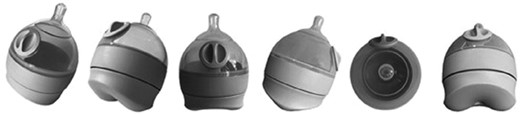
EUTM No. 018126468.
Finally, EUTM No. 018155734, illustrated in Figure 7 for the shape of a campervan, was refused for vehicles but allowed for ‘boats, trains, lorries, motorbikes, mopeds & scooters’.[36]
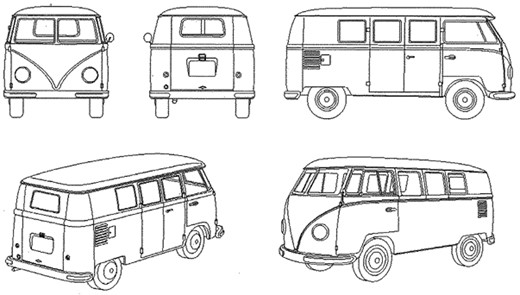
EUTM No. 018155734.
It is worth pausing to note that these ‘other’ product shape marks are being registered as inherently distinctive under the Henkel test, because they are deemed to ‘depart significantly from the norm’ for goods other than those which they actually embody. This is illustrated in the General Court’s decision,[37] which found that applicant’s vehicle shape (a Range Rover Evoke) should be refused for ‘vehicles for locomotion by land’ but could still be registered for ‘vehicles for locomotion by air and water’ because it clearly departed from the usual shape of boats and planes. Analogously, the shape of a campervan is not the normal shape of a motorbike and thus would be classed as inherently distinctive for these goods, even though the chance of the shape ever being used in that was is remote.
In applying the Henkel test so mechanically, it seems that EUIPO examiners are losing sight of the reality of how these registrations could be used in the future, and indeed, whether they will ever be used for the registered goods at all. I will suggest how these types of marks can be dealt with better below.
C. Which Marks Are Actually Being Registered?
While the mere act of filing an EUTM is no guarantee that it will be registered, refusal rates are fairly low, and 72% of shape marks filed during the 5-year period did proceed to registration (even if some faced refusal for some goods/services claimed), and almost all on the basis of inherent distinctiveness.
Drilling deeper, I investigated which types of shape marks are most likely to result in registration or refusal. This analysis, summarised in Chart 2 below, revealed applications for shape of packaging and all other mark types were more likely to proceed to registration than applications for product shapes. While the registration rate for the latter was only 51%, 80% of packaging marks were registered with similar percentages for the other categories of shape marks (logo—91%; service—91%; other—88%). Chart 2 also shows that product shape marks were more likely that other types of marks to face a range of adverse outcomes (i.e. cancellation, withdrawal or partial refusal), with the percentage being 42% for product shape compared to under 20% for other categories of shape marks.
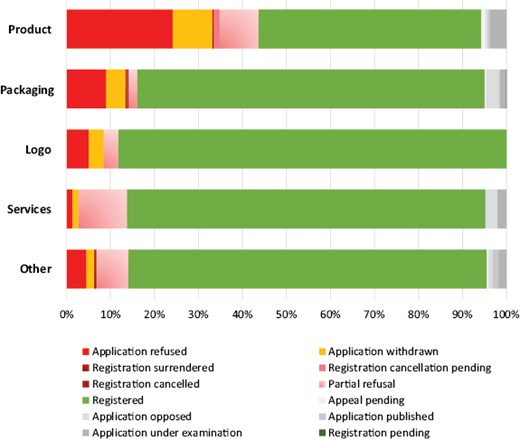
Mark Status by Mark Type.
We shall examine the basis on which product marks are being refused at the end of this section.
D. The Impact of Colour
This research also investigated the impact whether filing a colour mark had any impact on the chances of registration. As shown in Chart 3, although very similar numbers of shape mark applications were made in colour (n.1,077) and in black and white (‘B&W’) (n.947),[38] the outcomes were very different, with 81% of colour marks proceeding to registration compared to 63% of B&W marks.
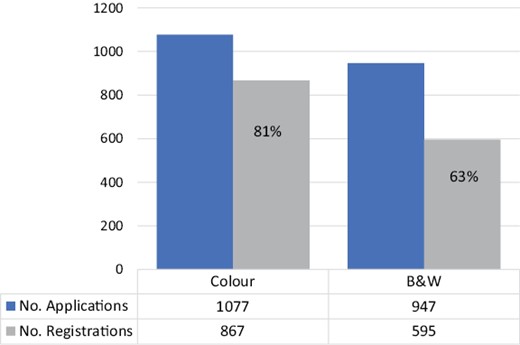
Colour vs. B&W Marks: Applications and Registrations.
These results are not entirely unexpected. The European Union Intellectual Property Network (EUIPN) Common Communication CP4 (‘CP4’)[39] states that, for oppositions, a B&W mark should not be considered identical to a colour form of the same mark, recognising that a mark for a specific colour is more limited in terms of its scope of protection. From a (lack of) distinctiveness perspective, we might speculate that colour gives more detail to the mark, allowing consumers to distinguish the marked goods of one undertaking more easily from competing goods of others. But we need to take care not to place weight on consumer familiarity with a particular combination of colours, which would only arise from use, and thus only be relevant to an enquiry of acquired, not inherent, distinctiveness.
Finally, most B&W marks are applications for ‘pure’ product shape marks, or shape marks with only weak additional distinctive matter. Since pure product shapes are typically represented using line drawings (hence their classification as B&W marks) it could be the underlying mark type (product shape) not absence of colour that is driving the lower registration rates for B&W marks. Registration prospects for ‘pure product’ marks are discussed at the end of the section.
E. The Impact of Added Non-Shape Matter
One phenomenon which cannot be overlooked is that many shape marks that are filed combine elements of 3D shape with additional non-shape matter. In a sense this is unsurprising, since this replicates the fact that in the ‘real world’, shapes of goods and packaging will often be used in association with words, labels and pictures, some of which may be conventional trade marks. However, it raises a question of whether it is the shape, or some other aspect of shape marks that is functioning as a trade mark doing the distinctiveness ‘heavy lifting’ in many cases.
As shown in Table 2 and Chart 4, of the 2,024 marks filed, 62% included non-3D matter, and of these, 87% proceeded to registration. In contrast, of the 38% of shape marks filed without non-3D matter, only 47% were registered. The high registration rate for those marks with additional matter is largely explained by the practice contained in Common Practice Note CP9 which states: ‘As a starting point, if a non-distinctive shape contains an element that is distinctive on its own, it will suffice to render the sign as a whole distinctive’.[40]
Table 2.
Applications and Registrations with/without Non-3D Matter
|
3D Shape Mark Includes Non-3D Matter?. |
No. of Applications. |
% of 3D Shape Applications. |
No. of Registrations. |
% of Applications Proceeding to Registration. |
|---|---|---|---|---|
|
Yes |
1,259 |
62% |
1,101 |
87% |
|
No |
765 |
38% |
361 |
47% |
|
3D Shape Mark Includes Non-3D Matter?. |
No. of Applications. |
% of 3D Shape Applications. |
No. of Registrations. |
% of Applications Proceeding to Registration. |
|
Yes |
1,259 |
62% |
1,101 |
87% |
|
No |
765 |
38% |
361 |
47% |
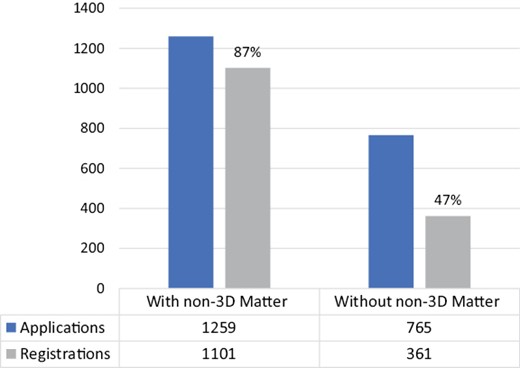
Application and Registration Rate for Shape Marks with/without Non-3D Matter.
To look beyond these ‘headline’ figures, I also recorded different forms of non-3D additions, but without attempting to differentiate further as to whether the added elements might be independently distinctive, or not. (Colour was recorded separately, so it was not counted as ‘non-shape matter’ for these purposes.) The categories for this exercise were: ‘none’; ‘word’; ‘word and device’; ‘getup including wording’; ‘getup without wording’ and ‘other’. As none of these are categories used on the EUIPO database, this is a somewhat imperfect exercise requiring judgments on my part as to which was the most appropriate category in each case, not least because different marks including different levels of detail.
‘Getup’ (or ‘trade dress’ as it is known in the USA) was a particularly challenging category, which I took to include a combination of features contributing the overall appearance of goods or packaging going beyond an individual word or device mark. EUTM No. 018365015 and EUTM No. 018400635, shown as left and right in Figure 8 below, are examples of what I have categorised as ‘getup including wording’ and ‘getup without wording’, respectively.
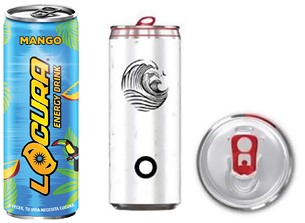
EUTM Nos. 018365015 (left) and 018400635 (right).
Despite the definitional difficulties, this seemed to be an important exercise, since the results capture the fact that very many of the shape marks registered are: (a) quite conventional in terms of their shape element, and rely on the additional matter, comprising words and/or devices for their distinctiveness; and (b) very specific, combining numerous detailed features of appearance, thereby affording a very limited scope of protection.
Chart 5 shows that of the 1,462 shape marks registered, shape marks featuring both getup elements and wording make up the largest category, representing 36% (n.527) of registered 3D shape marks. If to this, we add shapes marks featuring words (21%; n.306), devices (7%; n.103), and words plus devices (9%; n.125)—the majority of which is likely to have independent trade mark significance—then up to 73% of registered 3D shape marks include non-shape matter which could be (and perhaps have been) registered independently as trade marks.
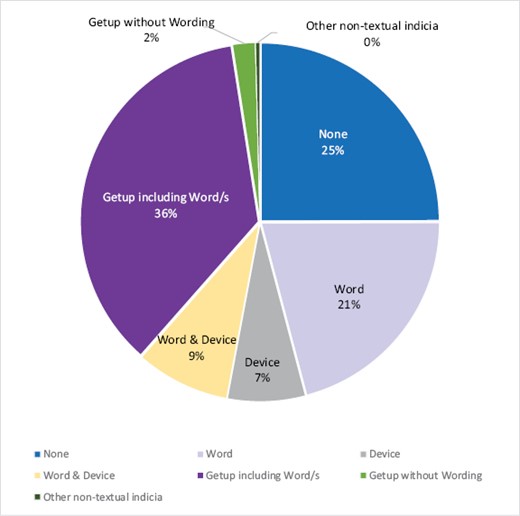
Registrations by Non-3D Matter.
This suggests that it is not necessarily the distinctiveness of the shape elements that are driving the registration rates, but rather the opposite. This in turn might cause us to question the commercial importance of the shape element of many of what the EUIPO term as ‘shape’ marks. As mentioned above, it is also likely that the scope of protection for these marks is narrow given that very many of them are tied to a specific getup combining a relatively banal shape and a specific arrangement of visual elements.
F. Which Aspect of a Shape Mark Is Having the Most Impact on Registration at EUIPO?
Attempting to assess how each of the different aspects might be relevant to the registration chances of a shape mark, I undertook a regression analysis. This seeks to estimate the relationship between an outcome (or ‘dependant variable’ to give it its correct name) and a factor, or set of factors, that might contribute to that outcome.
For this analysis, as the outcome was registration as a trade mark, I coded all marks that were registered as a ‘1’ and others, such as refusal, partial refusal, withdrawal, etc. as a ‘0’. The ultimate outcome for marks that were awaiting examination or under appeal, etc. was unknown, and these were treated as missing data for these purposes. The independent variables (factors that might influence the outcome) were the type of mark (product, packaging, logo, service, other), whether the mark colour or B&W, and whether the mark included any non-3D features. I selected a 95% confidence interval.[41] The results are shown in Table 3.
Table 3.
SPSS Regression Analysis
|
. |
Variables in the Equation. |
95% CI for Exp(B). |
|||||||
|---|---|---|---|---|---|---|---|---|---|
|
. |
B. |
SE. |
Wald. |
df. |
Sig.. |
Exp(B). |
Lower. |
Upper. |
|
|
Step 1a |
Product |
−1.097 |
0.251 |
19.114 |
1 |
<0.001 |
0.334 |
0.204 |
0.546 |
|
Packaging |
−0.420 |
0.263 |
2.560 |
1 |
0.110 |
0.657 |
0.393 |
1.099 |
|
|
Logo |
−0.377 |
0.513 |
0.539 |
1 |
0.463 |
0.686 |
0.251 |
1.876 |
|
|
Services |
0.271 |
0.294 |
0.850 |
1 |
0.357 |
1.312 |
0.737 |
2.335 |
|
|
Other |
1.198 |
0.283 |
17.976 |
1 |
<0.001 |
3.314 |
1.905 |
5.768 |
|
|
B&W/colour (0 = B&W) |
0.344 |
0.126 |
7.424 |
1 |
0.006 |
1.410 |
1.101 |
1.806 |
|
|
Presence of non-3D matter |
2.307 |
0.134 |
297.662 |
1 |
<0.001 |
10.040 |
7.725 |
13.047 |
|
|
constant |
0.220 |
0.268 |
0.675 |
1 |
0.411 |
1.247 |
|||
aVariables entered on step 1: Product, Packaging, Logo, Services, Other, B&W/colour (0 = B&W), Presence of non-3D matter.
For a result to be statistically significant, we need a result of 0.05 or below in the ‘Sig.’ column.[42] This is present in relation to whether the mark is the shape of a product, whether it is classed as ‘Other’, and the presence of non-3D matter. Additionally, whether the mark is colour or B&W is a ‘near miss’ at 0.06.
The impact each of each independent variable can be determined by considering the odds ratio in the ‘Exp’ column. This ratio expresses how many times more likely a mark with the characteristic under scrutiny is to be registered as compared to a mark without that characteristic. Thus, a colour mark is almost 1.5 times more likely to be registered than a B&W mark (although, this result falls just shy of the test for statistical significance), while a mark with non-3D matter is 10 times more likely to be registered than a mark with no non-3D matter. Also marks which fall within the ‘other’ category are 3.3 times more likely to be registered than other forms of mark. Finally, the odds ratio for marks that are product shapes, at 0.0334, falls below 1. This signifies that product shapes are 66.7% less likely to be registered than other forms of 3D marks.
In a sense this regression analysis exercise simply reinforces the findings identified in our discussion of the individual factors in Section 3, above, but it does go further by quantifying the individual impact that each factor has.[43] It is evident that the addition (or not) of non-3D matter is the single factor with the biggest impact on registration, i.e. non-shape factors are determining which shape marks are being registered.
G. Putting the Factors Together: Which Marks Are Being Registered?
To get a better grasp of which types of shape marks are being registered by EUIPO, we need to combine the data on the outcomes of applications for marks by mark type, colour and whether the mark includes non-shape matter. This task was undertaken by way of a four-way cross-tabulation using SPSS (although for ease of reading, the results data have been imported into an Excel spreadsheet which is reproduced as Table 4). This table details the outcome of each application by subcategory in absolute terms, which has then been translated into Chart 6, a stacked bar chart, indicating the percentage of each subcategory of mark that were registered, refused, etc.
Table 4.
SPSS Cross-tabulation
|
. |
Registered. |
Reg. Pending. |
Refused. |
Partial Refusal. |
Withdrawn. |
Cancelled. |
Cancel Pending. |
Surrender. |
Under Appeal. |
Opposed. |
Published. |
Under Exam. |
|---|---|---|---|---|---|---|---|---|---|---|---|---|
|
Product |
||||||||||||
|
B&W only |
100 |
0 |
138 |
50 |
49 |
0 |
0 |
0 |
7 |
1 |
1 |
24 |
|
Colour only |
52 |
0 |
55 |
21 |
19 |
0 |
1 |
0 |
2 |
2 |
3 |
7 |
|
+ non-3D matter (B&W) |
186 |
0 |
11 |
4 |
9 |
0 |
6 |
2 |
0 |
2 |
0 |
1 |
|
+ non-3D matter (colour) |
108 |
0 |
9 |
3 |
3 |
0 |
0 |
0 |
0 |
0 |
0 |
1 |
|
Packaging |
||||||||||||
|
B&W only |
43 |
1 |
39 |
10 |
10 |
1 |
2 |
0 |
1 |
0 |
0 |
6 |
|
Colour only |
48 |
0 |
17 |
0 |
7 |
0 |
0 |
0 |
3 |
0 |
2 |
1 |
|
+ non-3D matter (B&W) |
187 |
0 |
12 |
6 |
8 |
1 |
0 |
3 |
0 |
10 |
0 |
3 |
|
+ non-3D matter (colour) |
554 |
0 |
27 |
5 |
22 |
0 |
0 |
0 |
0 |
21 |
1 |
4 |
|
Logo |
||||||||||||
|
B&W only |
2 |
0 |
1 |
0 |
0 |
0 |
0 |
0 |
0 |
0 |
0 |
0 |
|
Colour only |
1 |
0 |
0 |
0 |
0 |
0 |
0 |
0 |
0 |
0 |
0 |
0 |
|
+ non-3D matter (B&W) |
14 |
0 |
2 |
1 |
1 |
0 |
0 |
0 |
0 |
0 |
0 |
0 |
|
+ non-3D matter (colour) |
35 |
0 |
1 |
0 |
1 |
0 |
0 |
0 |
0 |
0 |
0 |
0 |
|
Services |
||||||||||||
|
B&W only |
14 |
0 |
0 |
6 |
0 |
0 |
0 |
0 |
0 |
0 |
0 |
2 |
|
Colour only |
16 |
0 |
0 |
3 |
1 |
0 |
0 |
0 |
0 |
0 |
0 |
1 |
|
+ non-3D matter (B&W) |
23 |
0 |
0 |
4 |
1 |
0 |
0 |
0 |
0 |
1 |
0 |
0 |
|
+ non-3D matter (colour) |
41 |
0 |
2 |
0 |
0 |
0 |
0 |
0 |
0 |
0 |
0 |
0 |
|
Other |
||||||||||||
|
B&W only |
68 |
0 |
2 |
10 |
2 |
0 |
0 |
0 |
1 |
1 |
1 |
3 |
|
Colour only |
51 |
0 |
4 |
6 |
1 |
0 |
0 |
0 |
0 |
0 |
1 |
1 |
|
+ non-3D matter (B&W) |
20 |
0 |
1 |
1 |
1 |
0 |
0 |
0 |
0 |
1 |
0 |
0 |
|
+ non-3D matter (colour) |
40 |
0 |
3 |
0 |
0 |
0 |
0 |
1 |
0 |
0 |
1 |
0 |
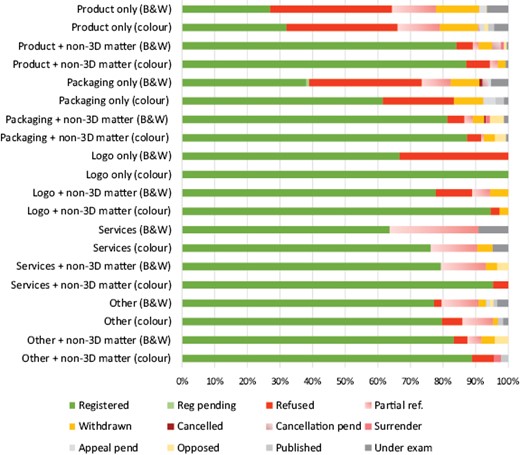
Status of Marks: Combining Type; Colour and Non-3D Matter.
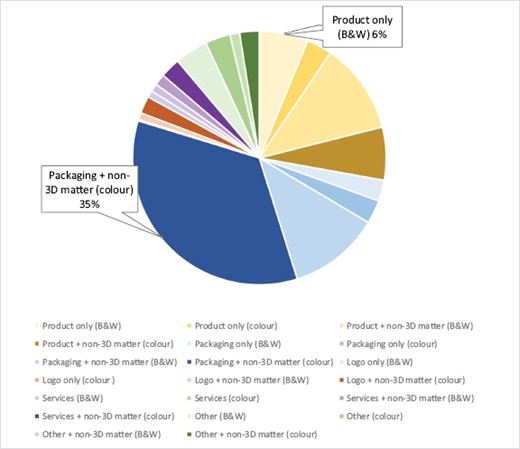
While space precludes an analysis of every outcome for each mark type, certain trends deserve highlighting. First, considering those shape marks which embody the shape of goods or packaging and which have been registered for those goods (i.e. the mark type which is perceived as the most tricky to register), then packaging marks which are filed in colour and which also include non-3D matter are the most successful, with 87% proceeding to registration.[44] In absolute terms, this kind of shape mark represents 35% of all shape mark registrations, as Chart 7 illustrates, i.e. more than double the number of the next biggest category of marks.[45] In some ways this is unsurprising. For one thing, these are the marks which are most likely to include material of independent trade mark significance, such as logos or word marks. Additionally, these marks are the most precisely defined and so pose the smallest competition-based risk and are also most likely to be recognised as trade marks by consumers. It is also worth noting that almost across the board, marks with non-3D matter had a considerably higher rate of registration than shape-only marks, the former accounting for 75% of all shape marks registered. Given the scale of this phenomenon, this suggests that in very many cases, what is really going on is that it is the additional matter, rather than the shapes that are driving registration, and so we might question how important the shape elements of such marks really are.
Shape Marks Registered by Type.
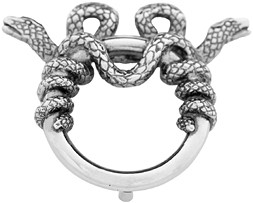
The analysis does reveal that, contrary to the received wisdom,[46] it is inaccurate to say that it is ‘impossible’ to register shape-only marks, but it is evident that it the most difficult form to register. There are a total of 395 shape marks registered without colour or non-3D matter, of which 100 are ‘pure product’ marks’. Some of these 100 marks are quite detailed designs which seem unlikely to be related to the product’s ‘technical function’, including EUTM No. 018000112, shown in Figure 9, which has been registered for goods including jewellery and handbags.
EUTM No. 018000112.
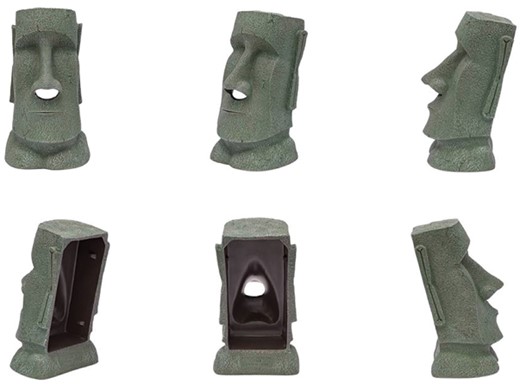
Other shape marks embody a fanciful shape for the goods, such as EUTM No. 018499788, illustrated in Figure 10, depicting a novelty ‘paper towel dispenser’ shaped like a Moai head (designed to dispense the towels through the figure’s nose).
EUTM No. 018499788.
Given the individuality of both these marks, one can see why, despite embodying ‘pure’ product shapes, they might not have been rejected as being necessary to obtain a technical result. However, the aesthetic nature of both shapes makes it surprising that the examiner neither questioned whether the shapes were adding substantial value to the goods, nor whether consumers would really perceive the shape as being an indication of origin, rather than just reflecting a decorative aspect of the goods. The presence of these marks on the Register may suggests that the substantial value exclusion may not be working as it should.
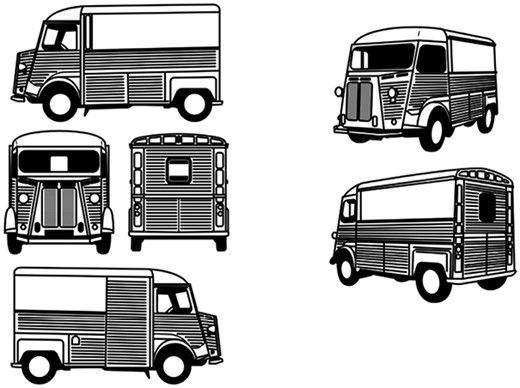
Other pure shape marks come closer to embodying the basic features of the goods for which registration was sought, which must surely raise competition concerns. For example, Figure 11 depicts the representations filed for EUTM No. 018021823, corresponding with a vehicle shape (the Citroen H-type van) registered for inter alia vehicles.
EUTM No. 018021823.
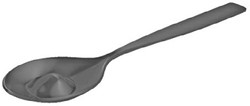
Figure 12 depicts EUTM No. 018093453—the shape of a dimpled spoon—registered, inter alia, for cutlery, while Figure 13 shows EUTM No. 018118936 for the shape of a brush, registered, inter alia, for ‘dental care articles for animals’.
EUTM No. 018093453.

EUTM No. 018118936.
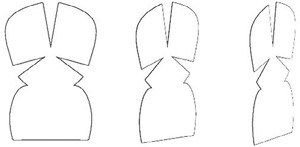
Figure 14 shows EUTM No. 017901075, registered for ‘artificial limbs; breast prostheses’. While this mark might look like an arbitrary or fanciful shape, review of the applicant’s website[47] reveals that the shape is actually a ‘blank’ which is stitched together for use as an implant. I would note in parentheses that this mark highlights what a challenge it can be for examiners to recognise precisely what the shape depicted in a decontextualised image actually represents.[48]
EUTM No. 017901075.
Surprisingly perhaps, none of these applications faced an objection based on either distinctiveness or technical functionality. Registration of these marks is concerning because the specific shape of the latter three products particularly might well relate to how the depicted products works, and all three would seem to embody a simple form of the goods, rather than a significant departure from the norm. In the next section, we shall consider the grounds of objection raised in more detail.
4. Results II: Impact of the Grounds for the Refusal of Registration
This section considers the various main substantive grounds for the refusal of registration arising in shape mark cases. In particular, it examines the relative prevalence of objections based on lack of descriptiveness and functionality, as well as the role that acquired distinctiveness plays in securing registration of inherently non-distinctive shape marks.
A. Which Ground Is Raised Most Often? What Does This Tell Us?
Conventional wisdom tells us that it is very difficult to register a shape mark. However, this study suggests that this is not so. Rather, 53% of shape marks (n.1,071) were registered without any objection being raised. Having read thus far, readers may find this result unsurprising, as we have seen already that most shape marks filed combine aspects of shape with non-3D matter, which is often independently distinctive, such a brand names (word marks) or logos (figurative marks). Not only does this additional matter remove these shape marks from reach of the functionality exclusions, but also the practice set out in CP9 mandates that such marks should proceed to registration.
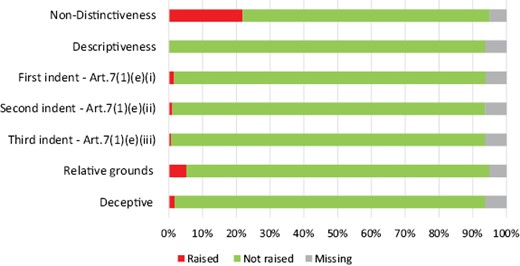
The frequency with which the various grounds for the refusal of registration were raised are set out in Table 5 and Chart 8. I opted to identify when each ground was raised, rather than just when a ground was maintained, because the balance between what should/should not be registered is considered in all such cases, not just those where the objection results in a refusal.
Table 5.
Which Grounds Are Being Raised?
|
. |
Raised. |
Not Raised. |
Missing. |
Total. |
Raised as %. |
|---|---|---|---|---|---|
|
Lack of distinctiveness |
467 |
1,565 |
105 |
2,137 |
22% |
|
Descriptiveness |
14 |
1,991 |
132 |
2,137 |
0.7% |
|
First indent: Art.7(1)(e)(i) |
1 |
2,004 |
132 |
2,137 |
0% |
|
Second indent: Art.7(1)(e)(ii) |
34 |
1,972 |
131 |
2,137 |
2% |
|
Third indent: Art.7(1)(e)(iii) |
22 |
1,981 |
134 |
2,137 |
1% |
|
Relative grounds |
111 |
1,917 |
109 |
2,137 |
5% |
|
Deceptiveness |
37 |
1,967 |
133 |
2,137 |
2% |
Frequency of Objections.
Of the grounds for the refusal arising in the data set,[49] lack of distinctiveness is the ground that was raised most frequently, arising in 22% (n.467) of shape mark applications.[50] Functionality objections were rarely raised. Technical functionality (the second indent) was raised in just 2% (n.34) of applications,[51] substantial value (the third indent) was raised in just 1% (n.21) of cases[52] and the natural shape exclusion (the first indent) was raised in just one case. If we focus on ‘pure’ shape marks (B&W product shapes without any non-3D matter), the functionality grounds were raised in a proportionately higher number of instances. There were 317 filings for ‘pure’ shape marks. The second indent was raised in respect of 18 of those filings, the third indent in 11 and the first indent in none. Thus, the functionality grounds were raised in relation to 9% of ‘pure’ shape filings, so still a very low percentage given the competitive risks inherent in registering such marks.
The research also identifies that the relative grounds of refusal were raised against 5% (n.111) of applications. Descriptiveness of the mark (as compared with other reasons for the mark’s non-distinctiveness) was also raised in less than 1% (n.14) of applications. This is noteworthy given the attempts[53] in the early days of EU harmonisation to argue that the shapes of goods were ‘descriptive’ of themselves. Deceptiveness (generally unrelated to the shape element of the mark) was raised in about as many instances (n.37) as functionality.
It is a cause for concern that the key grounds for objection are being raised in such a small percentage of cases. The low rate of functionality-based objection was particularly unexpected because (although no longer limited to shapes) the functionality provisions were specifically designed to protect against the particular competitive harms which may arise from the registration of product shapes as marks.[54] If the functionality objections are barely ever raised, let alone found, it means that the exercise of balancing of competition interests against consumer confusion and proprietor interests is just is not happening. The necessary conversations about just which shapes should be kept free in the interests of competition are just not taking place. We might try to explain this away. In terms of the ‘natural shapes’ exclusion, then perhaps most applicants are wise enough not to attempt to register a basic or generic shape. The meaning and extent of the exclusion for shapes which add substantial value of the goods mired in uncertainty, not least because of underlying doubt about whether there ever really is a competitive need to keep aesthetic shapes free.
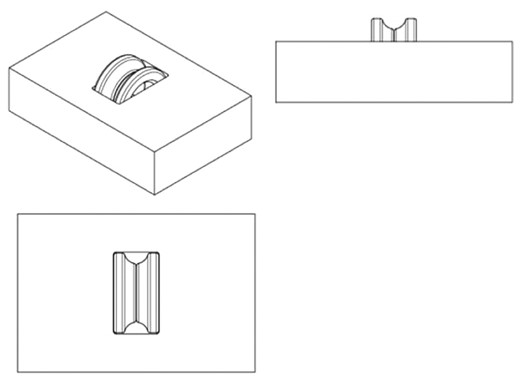
However, it is worrisome that equally little attention seems to being given to technical functionality, which impacts on how goods work, and therefore on the availability of competing goods to consumers. Indeed, it is possible to identify examples from the sample where technical functionality might have been raised but was not. For example, Figure 15 depicts EUTM No. 017869161 registered for goods including keys, key blanks, locks and barrels; Figure 16 depicts EUTM No. 017926259 registered for, inter alia, ‘blades’; Figure 17 depicts EUTM No. 016974644 registered for ‘Hand tools and implements (hand-operated); cutlery, razors (electric or non-electric), razor blades, razor knives’; and Figure 18 depicts EUTM No. 016394058 registered for a range of machine parts, including: ‘Linking devices …; couplings …; Workpiece locators …; Holding devices for machine tools; … Bearing housings; Shaft couplings as parts of machines’.
EUTM No. 017869161.
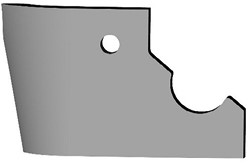
EUTM No. 017926259.
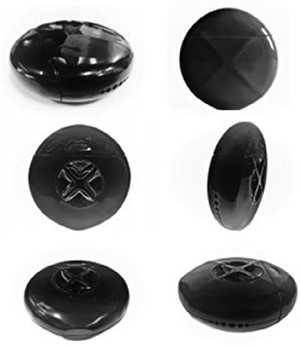
EUTM No. 016974644.
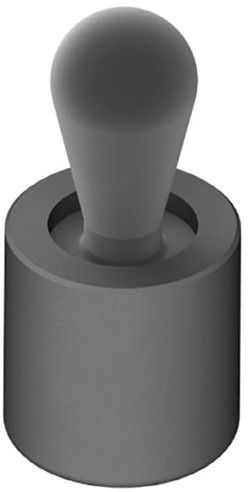
EUTM No. 016394058.
If a technical functionality objection is not even being raised for what appear to be fairly utilitarian-looking shapes, then lack of distinctiveness is serving as the bulwark protecting against the over-extensive registration of shape marks. This raises its own concerns because: (i) competition-based concerns, such as the need to ‘keep free’ are not meant to form part of the (lack of) distinctiveness consideration; and (ii) even if a lack of distinctiveness is found, this can be set aside if the applicant shows that the mark has acquired distinctiveness. In sum, the results suggest that there is very little space in the EUIPO system as it currently operates for competitors’ needs to be factored into the registrability analysis.
It might be observed that the large number of shape marks which are shape-plus-other-distinctive-matter means that there is little role for functionality objections because shapes are only excluded as functional if they consist exclusively of the shape, or another characteristic, of the goods. Thus, the addition of non-3D matter takes the marks outside the scope of the functionality provisions. Still, in that situation one might expect to see more examples of functionality objections being raised and then rejected, and of the outer limits of when a shape is exclusively functional being discussed. We might certainly have expected to find functionality being raised in a greater percentage of ‘pure’ shape applications.
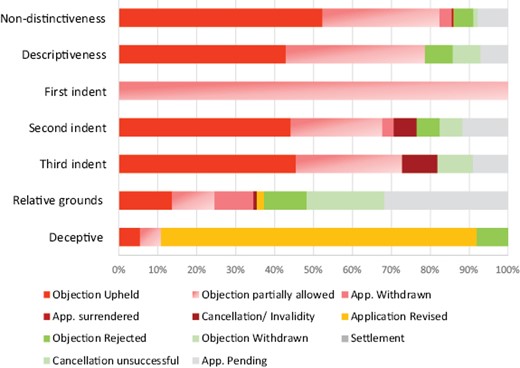
B. Outcome of the Grounds
Having considered the frequency with which the various grounds for refusal are raised, the next question to ask is: if one of the grounds for refusal is raised, how likely is it to lead to an adverse outcome for the trade mark applicant? Here, I classed several outcomes as ‘adverse’. The most obvious is where the objection is upheld such that the application is refused. However, in some instances, the objection was upheld for some goods but not for others, which I classified as a ‘partial rejection’.[55] Withdrawal of the application was also classed as an adverse outcome since in most instances the application is withdrawn when it becomes clear to the applicant that the application is likely to be rejected.[56] A post-registration cancellation or invalidation is also included in this category.
Table 6 and Chart 9, below, summarise the various outcomes of objections.
Table 6.
Outcomes of Objections
|
. |
Objection Upheld. |
Objection Rejected. |
Objection Withdrawn. |
Objection Partially Allowed. |
Application Revised. |
Settled. |
Cancelled/Invalidity. |
App. Pending. |
App. Withdrawn. |
App. Surrendered. |
Cancellation Unsuccessful. |
|---|---|---|---|---|---|---|---|---|---|---|---|
|
Non-distinctiveness |
245 |
23 |
4 |
141 |
1 |
0 |
2 |
37 |
15 |
0 |
1 |
|
Descriptiveness |
6 |
1 |
0 |
5 |
0 |
0 |
0 |
1 |
0 |
0 |
1 |
|
First indent |
0 |
0 |
0 |
1 |
0 |
0 |
0 |
0 |
0 |
0 |
0 |
|
Second indent |
15 |
2 |
1 |
8 |
0 |
0 |
2 |
4 |
1 |
0 |
1 |
|
Third indent |
10 |
0 |
2 |
6 |
0 |
0 |
2 |
2 |
0 |
0 |
0 |
|
Relative grounds |
15 |
12 |
22 |
12 |
2 |
0 |
1 |
35 |
11 |
0 |
0 |
|
Deceptive |
2 |
3 |
0 |
2 |
30 |
0 |
0 |
0 |
0 |
0 |
0 |
|
GI |
5 |
1 |
0 |
2 |
21 |
1 |
0 |
2 |
1 |
0 |
0 |
|
Mis-classified goods/services |
2 |
1 |
1 |
18 |
74 |
0 |
0 |
0 |
0 |
0 |
0 |
|
Formalities |
2 |
0 |
0 |
7 |
86 |
0 |
0 |
1 |
0 |
0 |
0 |
Success by Ground.
Some of this data cannot be taken at face value, as the very low number of objections raised under a particular ground then each outcome has a disproportionate effect on the apparent success rate for each objection. This is illustrated most strikingly in the respect of the first indent, which seems to have a 100% success rate of partial rejection, but this figure is based on a single case. Nevertheless, it is possible to make some observations.
As we have seen in Part A above, lack of distinctiveness was the objection raised most frequently, but this additional analysis reveals that when this objection is raised, it is also the ground of objection that is most likely to be upheld—resulting in an application being refused or partially refused in 82% of cases, and adverse outcomes in 88% of cases. This compares to 68% and 76% respectively in respect of objections under the second indent; 73% and 82% of objections under the third indent, and 79% of descriptiveness objections resulted in refusal. Thus, while most shape marks face no objections at all, once a substantive objection has been raised, an adverse outcome will follow in the overwhelming majority of cases.
Deceptiveness is notable for the fact that the objection did not often lead to an adverse outcome, because applicants were able to revise their specification of goods/services to overcome the objection.
Finally, it is noticeable that where a third-party raised an objection under the relative grounds for the refusal, based upon earlier rights, the application was refused or partially refused in only 25% of cases. One might speculate that an EUIPO examiner will only raise an absolute grounds objection when they are confident that it is appropriate, whereas the owner of an earlier trade mark, or other right, might oppose (or otherwise object) more speculatively and strategically, or they might just be less familiar with when two rights are likely to be held to conflict. Equally, objections based on the relative grounds were only rejected in 11% of instances. Instead, many disputes were resolved through pre-decision actions: withdrawal of the application or of the relative grounds objections, in some cases following amendment of the specification to remove conflicting goods or services.
More anecdotally, most relative ground disputes arose based on conflict with the non-3D matter included in the mark. Very few of the objections were based on earlier shape marks.[57] Thus, for the most part, these decisions shed little light on the difficult question of how potentially-conflict 3D shapes should be compared in inter partes disputes.
C. Impact of the Grounds by Type of Mark
Building on the analysis in Parts A and B, but focussing in on the absolute ground of objection, this part looks more closely at when lack of distinctiveness and functionality objections are raised to the various sub-categories of 3D shape marks.
(i) Distinctiveness—Art.7(1)(b)
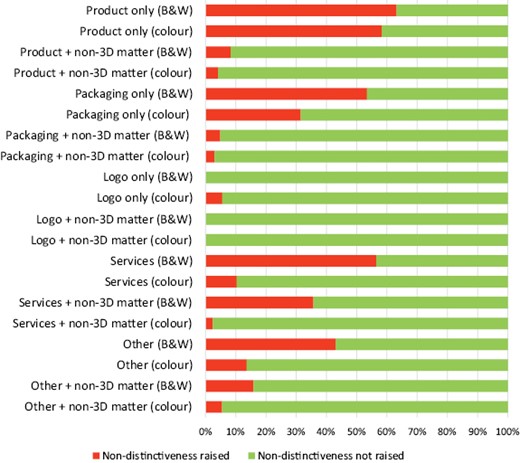
The earlier results have shown that although most shape mark applications proceed to registration without facing any objection, the most common objection faced was lack of distinctiveness, which arose in 22% of cases. This figure does not provide a complete picture because certain mark types are more susceptible to distinctiveness objections than others. Chart 10 illustrates that for pure product shape marks, the objection rate on this ground rose to 63%, while the objection rate for colour product marks with no non-3D matter was similar, at was 58%. At the other end of the spectrum, lack of distinctiveness was raised in just 3% of applications for colour packaging marks including non-3D matter.
Non-Distinctiveness Objection Raised by Mark Type.
(ii) Technical Functionality—Art.7(1)(e)(ii)
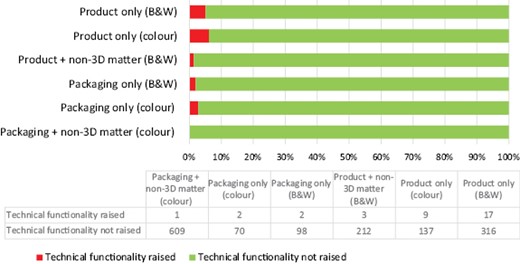
Chart 11 illustrates the same trend in relation to objections based upon potential technical functionality. While overall, technical functionality was raised in only 2% of applications, it was raised in 5% of applications for pure product marks, and 6.5% of colour product marks with no non-3D matter. As no technically functionality objections were raised in respect of ‘Product + non-3D matter (colour)’, ‘Packaging + non-3D matter (B&W)’ marks, or any form of ‘Logo’, ‘Services’ or ‘Other’ marks, these are not included on the chart.
Technical Functionality Objection Raised by Mark Type.
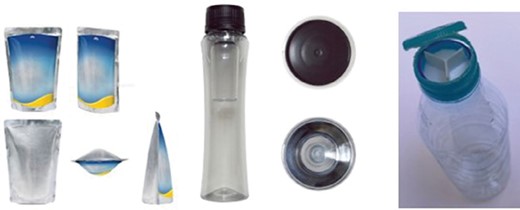
It is also interesting to note that technical functionality was also raised in a small number of cases involving the shape of packaging, including EUTM Nos. 017623943, 018021951 and 018497462 illustrated (left, centre and right, respectively) in Figure 19. This does not sit easily with at least the literal wording of the provision, which refers to the shape or other characteristic of goods. Also worth noting is that there were no technical functionality objections raised against services. Perhaps this is to be expected given the opinions, detailed above, that the exclusion does not apply to services. Nonetheless, I would argue that this is unfortunate given that, as I argue below, in some circumstances registration of product shapes for services may adversely affect the ability of competitors to offer those services.
EUTM Nos. 017623943 (left), 018021951 (centre) and 018497462 (right).
(iii) Substantial value—Art.7(1)(e)(iii)
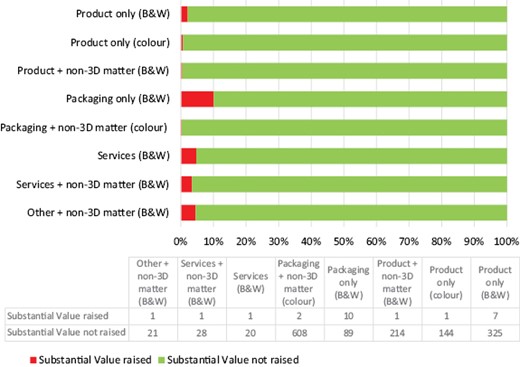
Objections based on substantial value were also raised in a very small number of cases, detailed in Chart 12, but here too there are pockets of mark types where it was more prevalent. The highest prevalence was in relation to shape of packaging marks (without colour or non-3D matter) where it was raised in 11% of cases. No substantial value objections were raised in the categories of ‘Product + non-3D matter (colour)’, ‘Packaging only (colour)’, ‘Packaging + non-3D matter (B&W)’ marks, any ‘Logo’ marks, ‘Services (colour)’, ‘Services + non-3D matter (colour)’, ‘Other (B&W)’, ‘Other (colour)’ and ‘Other + non-3D matter (colour)’ marks, and so they are not included in the chart.
Substantial Value Objection Raised by Mark Type.
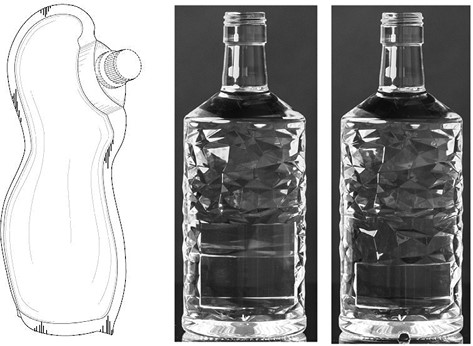
Certain of these package shapes were, for want of a better word, relatively mundane in nature, such as the nut-shaped pouch for foodstuffs covered by EUTM No. 018042935 and the faceted bottle of EUTM No. 018042569, shown left and right, respectively, in Figure 20.[58]
EUTM Nos. 018042935 (left) and 018042569 (right).
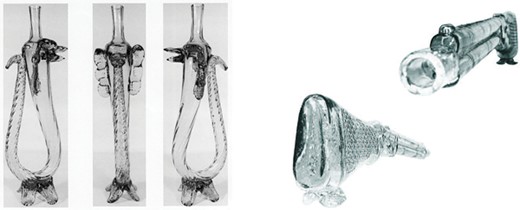
Others were more aesthetic, making it more likely the product would be bought as much for the appeal of the packaging as any contents, including EUTM Nos. 017886254 and 017886253, shown left and right respectively, in Figure 21.
EUTM Nos. 017886254 (left) and 017886253 (right).
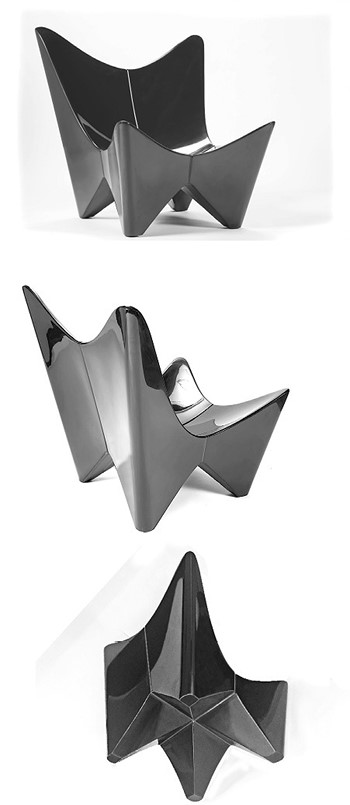
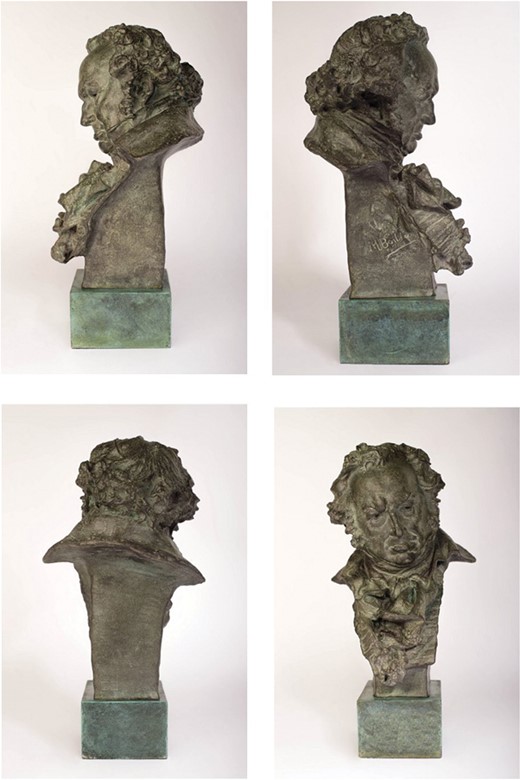
Finally, and anecdotally, there were other marks which appeared to be equally aesthetic in nature as the examples given above, but where no substantial value objection was raised. These included the chair shape covered by EUTM No. 018061202 designating furniture and stone sculptures, shown in Figure 22, and the shape of a bust covered by EUTM No. 018159612, registered for ‘trophies’, inter alia, shown in Figure 23. Indeed, the sheer number of primarily aesthetic/decorative shape marks being registered without any objection being raised under Art.7(1)(e)(iii) suggests that substantial value provision is not working as it should. We will discuss reasons why in Section G, below.
EUTM No. 018061202.
EUTM No. 018159612.
D. What Is the Role of Acquired Distinctiveness?
As was flagged in the introduction, it has been argued that because so few shape marks will meet the Henkel test for inherent distinctiveness—without then falling foul of the substantive value exclusion, that the EU trade mark system is incentivising investment in promoting shape marks, so that they may acquire a distinctive character through use.[59] So far, the results have demonstrated that the first element two elements of this proposition are incorrect, since most shape marks are deemed inherently distinctive, and objections based on substantial value are rarely raised. This part reviews the role that acquired distinctiveness plays in the registration of shape marks. While the proposition is logical (although based on the assumption that business’ advertising strategies are driven by the desire to obtain trade mark protection, rather than, e.g., to promote a product’s qualities, which is itself open to question), the figures do not bear it out.
Acquired distinctiveness,[60] whereby a mark that would otherwise be unregistrable on grounds of descriptiveness, lack of distinctiveness or genericity can be registered if it is demonstrating that consumers have learnt to recognise the mark as an indication of trade origin, was only raised in 71 of the 2,137 records analysed (data was not available on 118 of the records). By contrast, lack of inherent distinctiveness was raised in 498 decisions and 12 decisions raised descriptiveness. Both these grounds for refusal can be overcome by a demonstration of acquired distinctiveness, yet it seems that applicants are not even trying to do so. In terms of success, only eight shape marks in the study were found to have acquired distinctiveness, suggesting that the academic orthodoxy, whereby shape marks can only be registered based on acquired distinctiveness, is ripe for revisiting.
There are, perhaps, various factors in play here. One reason why acquired distinctiveness features so rarely is that it only becomes relevant where the application faces an objection that the shape mark is not inherently distinctive which cannot be overcome by argument. We have seen that such objections are simply not raised in most cases, either because the shape is deemed to depart significantly from the norm, or because the overall mark is distinctive (under CP9) because shape element of the mark is combined with distinctive non-3D matter. Also, an applicant can only attempt to argue acquired distinctiveness if the mark has been in use for a significant period (typically 5 years) before the EUTM was filed. As far as can be ascertained, there have been no investigation as to the proportion of EUTMs (let alone shape marks) which have been used prior to filing.
However, there is one significant reason why there is so little a role for acquired distinctiveness, even when evidence of trade mark use is available. The CJEU has held that where the objection of lack of inherent distinctiveness applies in all EU member states,[61] this can only be overcome based on the applicant demonstrating acquired distinctiveness across the entire EU.[62] This is a very difficult standard to reach and a costly standard to evidence, even for the largest market actors.[63] This phenomenon is not limited to shape marks. Of the 610,399 EUTMs registered during the period of this study, only 144[64] (around 0.02%) were accepted based on acquired distinctiveness. The data for shape marks shows that it is not only that applicants are failing to demonstrate acquired distinctiveness—they are not even attempting to argue it.
5. A Comparison with the UK
Unfortunately, the UK Intellectual Property Office (UKIPO) does not provide the same level of readily searchable, publicly accessible data on UK trade mark filings as that of the EUIPO. In particular, the UK Register search facility does allow searching by type of mark, nor does the UKIPO publish the grounds of refusal for applications which were refused prior to publication.
However, the UKIPO were kind enough to provide aggregated data on registrations of 3D marks from April 2013 to the beginning of December 2022, set out in Table 7. This data should be read subject to the caveats given below.[65] Although this does not mirror the time period of my study, it does give an understanding of trends before the UKIPO.
Table 7.
|
Total identified |
1,887 |
|
Under examination |
30 |
|
Published |
17 |
|
Opposed |
2 |
|
Registered |
1,019 |
|
Dead/expired |
520 |
|
Merged |
1 |
|
Refused |
93 |
|
Surrendered/removed/withdrawn |
202 |
|
Appealable/cancelled/cancellation application |
3 |
|
Total identified |
1,887 |
|
Under examination |
30 |
|
Published |
17 |
|
Opposed |
2 |
|
Registered |
1,019 |
|
Dead/expired |
520 |
|
Merged |
1 |
|
Refused |
93 |
|
Surrendered/removed/withdrawn |
202 |
|
Appealable/cancelled/cancellation application |
3 |
Firstly, 54% (n.1,019) of the shape marks identified remained registered at the time the data was collected, which is lower than the 72% registration rate identified in the EUIPO study. However, this does not take marks in the ‘Dead/Expired’ category into account, that may once have been registered but have lapsed.
In terms of refusal rate, only 5% (n.93) of the marks in the UKIPO data set were classed as ‘refused’, compared to the 15% refusal rate of EUTM shape marks. Again though, this does not take account of marks in the ‘Dead/Expired’ category that were opposed and never registered which, in the EUIPO would be categorised as ‘Refused’.
There is a need for caution with any conclusions from this data, given the different time periods of the two studies, the fact that it is unclear whether the UKIPO classifies a ‘3D shape’ mark in the same way as the EUIPO, and the likelihood that it would more straightforward to demonstrate acquired distinctiveness within a single territory than the entire EU. Nonetheless, there may be scope for further study as to whether there are subtly different examination practices that may somehow be influencing the registration rates in the two jurisdictions.
6. Lessons to Be Learnt
This section reviews potential lessons to be learnt from the data concerning which shape marks are being registered at the EUIPO, and why some, but not others, are being refused registration.
A. The Diverse Universe of European Shape Marks
The first lesson is the sheer diversity of mark types that fall within the ‘3D shape’ category on the EUIPO Register, spanning not only the shape of goods and packaging, but encompassing logos, shapes used in respect of services, and shapes of goods registered for other goods.
(i) Shape marks generally
While the 15% refusal rate was significantly higher than that for trade marks generally (4%), it remains the cases that 72% (n.1,462) shape marks were registered at the EUIPO during the 5-year period of the study, only eight of which (less than 0.5%) were accepted based on acquired distinctiveness. Thus, we can state with certainty that the academic orthodoxy that it is almost impossible to register a shape mark in the absence of acquired distinctiveness, while understandable, given the CJEU’s jurisprudence, does not reflect the practice of the EUIPO.
One explanation is that most shape marks are deemed to be inherently distinctive, not because of the inherent distinctiveness of the shape, but because the shape element is combined with other distinctive matter. CP9 then points strongly towards registration, but based on the non-3D matter, not the shape. It seems quite likely that the academic commentators did not have such marks in mind in commenting on the ‘impossibility’ of shape mark registration. Others shape marks are being registered in respect of goods other than those that the product form represent (e.g. EUTM No. 17520404 covering a Lego brick for light fixtures), or in relation to services. The impact of this latter category of marks will be discussed below.
(ii) ‘Pure’ shape marks
Yet, it is still the case that pure shape marks (i.e. consisting of the shape of goods without any additional distinguishing matter and/or colour) are being registered too, and without acquired distinctiveness. During the 5-year period of the study, 370 such applications were filed of which 100 (27%) were accepted (a far lower acceptance rate than shape marks overall at 72%). This mark type raises the greatest risk of competitive harm, as it is most likely to embody only the elements that competitors need to replicate to produce a competing product that functions in the same way, or that consumers want to purchase for aesthetic or other non-origin-related reasons. Unlike shape marks including additional distinctive matter, in the case of pure product shapes, there is nothing that competitors can add, or take away, to ‘design around’ the registered mark.
It is problematic to say that such marks should never be registered,[66] not least because both the CJEU[67] and legislation[68] states that no type of mark should be prima facie excluded from registration. However, it seems reasonable that such marks should be subject to special scrutiny to ensure that they really will be perceived by consumers as being indicative of origin and that they do not block competitor access to technical or otherwise valuable product features, as envisaged by the functionality provisions. Arguably the second stage of this scrutiny is not taking place as it should. Competitors’ interests are recognised during the Art.7(1)(e) examination, but as we have seen, Art.7(1)(e) is barely considered. Indeed, it was only raised in relation to 5% of ‘pure product’ marks. Instead, it is lack of distinctiveness that is most often raised in relation to these marks, but as we have seen, lack of distinctiveness is meant to focus purely on consumer perception and not on competitors’ interests.
As I argue below, distinctiveness will generally act as a proxy for technical functionality (if a shape is ‘technical’, consumers will see it as contributing to how the object works, rather than indicating trade origin) but this is not inevitably the case. Since functionality is raised so infrequently, it is difficult to point authoritatively to examples where the mark is distinctive but has been rejected as functional. Additionally, in the absence of evidence, there is a degree of guesswork as to which characteristics of shapes should be deemed functional. However, I would argue that it is possible to identify tentatively several marks which might depart from the norm (meaning that they were not challenged on distinctiveness) but which have features suggesting that the shape might be technically necessary or adds substantial value. For example, Figure 24 depicts EUTM No. 016946683, registered for ‘respiratory apparatus and instruments including compressor nebulizer systems and parts therefor’. This seal-shaped inhaler presumably looks different from the shape of other inhalers on the market, but it seems arguable that the animal shape combines functional features (vents, mouthpiece, etc.) in a form that works particularly efficiently for children because the friendly shape encourages compliance in taking the medication.[69]
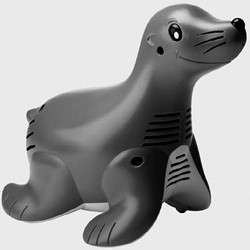
EUTM No. 016946683.
Similarly, EUTM No. 018115430 registered for various beams and construction components, illustrated in Figure 25, provides a further example. While this mark did face an objection based on lack of distinctiveness, it was withdrawn, and no objection was raised, questioning whether the product’s shape had any bearing on the component’s technical function under Art.7(1)(e)(ii).
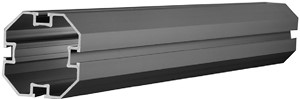
EUTM No. 018115430.
A further option could be to require acquired distinctiveness for pure shape marks,[70] both because consumers are less likely to see such marks as indicative of origin, and also to limit the protection of the most competitively dangerous marks to those where third-party use is most likely to cause actual consumer confusion. This would mark a departure for EU trade mark law, which generally does not discriminate between different types of marks.[71] Given how difficult it is to prove acquired distinctiveness, this might have the unintended consequence of rendering all such marks unregistrable.
B. Non-Shape Matter Is the Driving Force of Shape Registration
One particularly surprising finding was just how many shape marks featured additional non-3D matter. This category represented 75% of registered shape marks. In most of these cases, the additional matter had independent trade mark significance, meaning the shape aspect of the mark was afforded little, if any attention during substantive examination, as per the CP9 practice. It is therefore reasonable to question what trade mark owners gain by including the shape element in the mark. There are many examples of bottles and cans, such as those in Figure 8 above, where the shape of the can is entirely conventional. These sit uneasily as shape marks because it is not the shape element which is underpinning the registration—rather it is the non-shape matter capable of independent registration.
Viewed from the other end, it is questionable what scope of protection such a mark will afford, especially in instances where the non-3D matter is very detailed and specific. Certainly, there is a need for caution to ensure that marks which combine non-distinctive 3D matter and distinctive non-3D matter are not enforced against later uses where confusion or potential dilution claims arise only in respect of the non-distinctive shape.[72] There is reason to be concerned about this, as there are non-use cases where the overlap between the mark as registered and the mark as used is the shape element, rather than the distinctive word element.[73]
Part of the problem here may be that undertakings are keen to protect the getup of their products against counterfeiters and perhaps even ‘own brand’ look-a-like goods. Yet there is no specific place in the EU IP system for protecting (or even thinking about the specific needs and characteristics of) getup and so registering an anodyne packaging shape combined with labelling is a strategy they have adopted. I suggest that, given the prevalence of getup registrations, we might do well to give more detailed consideration to the special requirements of this form of protection, including perhaps exploring the re-introduction of a system of mandatory disclaiming of non-distinctive elements of marks as a requirement for acceptance.[74]
C. 3D Marks for Services
I was also surprised by the number of shape marks filed in respect of services. These represented 6% (n.129) of filings, of which 91% (n.118) proceeded to registration. Ultimately 8% of shape marks registered included a claim for services. Some of these, discussed in Section 3.B.ii above, are the shapes of goods that could be used in providing the services designated. Granting exclusive rights for such marks could foreclose competition in the services market, since competitors could be prevented from using the same or similar-looking products when competing with the trade mark owner. While it is not clear that the functionality provisions apply to services, it does seem clear that same sort of competition concerns may arise that the Art.7(1)(e) provisions are designed to address. It is hard to see why, as a matter of principle, such concerns should not be considered during the examination stage in relation to both goods and services.
How could these concerns be addressed? In some cases, they are addressed indirectly by finding that the shape of a product lacks distinctiveness in respect of the services for which it is used.[75] This practice does not seem to be applied consistently. A better option might be reading the existing Art.7(1)(e) as setting a minimum standard that can also be read more expansively, following the CJEU’s approach in Davidoff v Gofkid.[76] After all, the provision does not exclude a consideration of service marks. Another option would be to expand the scope of the functionality provisions to expressly cover registration of shapes and other characteristics for services. Although this is unlikely to happen at the EU level, post-Brexit there may be scope for such a development in the UK.
D. Acquired Distinctiveness Is Moribund
As above, academics have (understandably) assumed that so few product shapes will be inherently distinctive, that registration will only proceed based on acquired distinctiveness. Yet, we have seen, in Section 4.D, that acquired distinctiveness plays almost no role in the registration of shape marks, reflecting—at least in part—how difficult CJEU jurisprudence has made it to demonstrate that an EUTM for a shape has acquired distinctiveness, since acquired distinctiveness must be shown in all Member States.[77] The side-lining of acquired distinctiveness is concerning and suggests that the standard for demonstrating acquired distinctiveness for EUTMs might have been set too high, leaving applicants to resort to a patchwork of national registrations in EU member states where acquired distinctiveness can be shown. Ultimately, acquired distinctiveness was included in the trade mark legislation and so for it to be unusable would seem, as I have argued elsewhere,[78] to be constitutionally inappropriate.
E. Strategic Filings and Blocking Registrations
The registration of product shapes for goods other than those that the shape represents is another worrying trend. Many such applications had been filed with wider specifications, but faced partial rejection for the goods depicted by the representation, but were allowed for other goods, including those which were similar or connected to the goods covered by the partial rejection.
The difficulty with these marks is two-fold. First, as with the problematic shape registrations for services discussed above, the scope of protection for these marks, once registered, extends to both the same and similar goods covered by the specification. Where a product shape has been protected for goods similar to those covered by the refusal, the owner is still able to instigate infringement proceedings in respect of third-party use for the refused goods, thereby negating the EUIPO’s refusal.
Ideally this problem could be addressed at the examination stage, if the examiner were to consider whether an objection that, for example, a product shape is devoid of distinctive character might apply not just to those particular goods represented by the mark, but also to broader terms within the specification which would encompass those goods and/or to related goods and services. A further possibility is for tribunals considering any infringement case involving a shape mark to consider the file history and refuse to enforce the mark against any goods for which the mark had been refused. Alternatively, requiring acquired distinctiveness for ‘pure’ shape marks, as discussed in Part A above, would reduce the possibility of purely strategic registrations as applicants would be unable to register marks as ‘blocking tools’ unless there was actual use for those goods. Though this would only be a viable option if the requirements for acquired distinctiveness for shape marks were pitched at a reasonable, achievable standard.
A further issue with these related-goods registrations is that in many cases, it is difficult to envisage just how the owner would ever be able to use the mark for the goods covered by the registration. For example, for the shape mark shown in Figure 7, does Volkswagen really have any plans to enter the aerospace market, let alone produce an aeroplane shaped like a campervan? Overly wide registrations are particularly topical, with the UK Supreme Court set to rule, in Skykick,[79] whether a registration is invalid on the grounds of bad faith if the specification of goods or services extends beyond those that the applicant has an intent to use. Arguably, the practice of registering a shape mark for certain goods/services with the sole intent of blocking others from producing other goods (being those represented by the shape) might already be considered an act of bad faith in the EU, following Lindt[80] and Skykick (CJEU).[81]
F. Side-Lining of Functionality and the Prominent Role of Distinctiveness
As we have seen, although the functionality provisions of Art.7(1)(e) were specifically included in the EU trade mark legislation to address the competitive risks raised by the registration of shape marks, they are barely even raised, let alone cited as a ground for the refusal of registration. Moreover, functionality, when it is raised, is almost always done so in conjunction with lack of distinctiveness. I was only able to locate 12 instances where Art.7(1)(e)(ii) or Art.7(1)(e)(iii) was raised without there also being an objection pursuant to Art.7(1)(b). This might make us query whether, in practice at least, there is a truly independent role for examination based on the functionality grounds.[82]
Does this matter? In terms of outcome, perhaps not. There is a significant overlap between the two provisions, as it is often the case that a shape mark which is technically functional because its shape relates to how a product works will also be a shape which consumers will not perceive as being indicative of origin. In fact, lack of distinctiveness seems to be a quite robust determinant of trade mark registration in this context. As we have seen, once lack of distinctiveness is raised, it is highly likely that the application with then be rejected or withdrawn, meaning a further examination of functionality would only replicate the same outcome, albeit for subtly different reasons.
However, the CJEU has stated explicitly that the sole focus of the distinctiveness examination is consumer perception, not other normative considerations.[83] Thus, without a shift in the public policy considerations adumbrated behind that article, lack of distinctiveness can at best act as an imperfect proxy for the competition concerns that functionality is designed to protect. Yet, if functionality is not discussed, it means that the explicit conversations about what shapes should be kept free for competitors are not taking place.
A further difficulty with lack of distinctiveness as the main ground for refusal of shape marks is that, unlike Art.7(1)(e), it can be overcome by acquired distinctiveness, leading to the ultimate registration of the mark. While this is troubling on a theoretical level, in practice this research has found that it is exceptionally difficult to show that an EUTM has acquired distinctiveness, meaning that the risk of a competitively necessary mark falling into the hands of a single undertaking because consumers have come to recognise it as a trade mark are very slight indeed.
One simple way to bolster the importance of functionality would be to revert to the position suggested by the CJEU in Philips v Remington, whereby functionality is considered before distinctiveness in shape mark cases.[84] This would force examiners to engage in a consideration of functionality which is often being side-stepped at present.[85]
G. Substantial Value: Overlap with Distinctiveness and a Doctrinal Deficit
The overlap between findings of lack of distinctiveness and shapes adding substantial value is less explored. Logically one might assume that consumers who are purchasing shapes of goods and packaging primarily because of their decorative value, or other aesthetic appeal, will not consider the shape also serves as an indicator of origin. The difficulty is that the shortcut for excluding inherently non-distinctive shapes, set out in the CJEU’s Henkel test, points in a different direction from the substantial value exclusion, such that shapes which should be barred from registration under the substantial value exclusion might well be accepted as distinctive because they depart significantly from the norm.[86]
Anecdotally, the marks examined also seem to bear out this out. As noted in Section 4.C.iii, there were a considerable number of marks having a largely aesthetic appearance which were registered. Given the trend that we have identified in relation to technical functionality, we might analogously expect few such marks to be challenged under Art.7(1)(e), but then this to be compensated to some extent by refusal under Art.7(1)(b). However, the same trend cannot be seen in relation to substantial value, and ‘aesthetically pleasing’ marks are being registered without being challenged either as to their distinctiveness nor on functionality grounds. Thus, lack of distinctiveness is serving as a poor proxy for Art.7(1)(e)(iii), and instead, potentially aesthetically functional marks are being registered without proper scrutiny.
This mismatch could be addressed if, as emphasised in London Taxi,[87] examiners and decision-makers stayed alert to the fact that the Henkel ‘substantial departure’ test for inherent distinctiveness is merely a judicially created starting point, which should not detract from the true focus—the proper question is not whether consumers will perceive the shape applied for as being ‘different’ from other shapes, but whether the shape mark in question will be perceived by consumers (perhaps on account of any differences from the usual shape) as being indicative of origin.
H. The Secret Life of Normativity
Having said that lack of distinctiveness is not normative, it is striking that there is an apparent correlation between the marks that are being registered and refused, and their likely impact on competition. Those mark types arguably having the greatest impact on competition are most often refused registration, while those with the least are most frequently registered. While it could be that this is a convergence in outcomes, it is also possible that the reality of the registration of shape marks is a manifestation of trade mark law adopting a normative rather than empirical approach (even if this is not explicitly acknowledged), as described by and advocated for by Dinwoodie.[88]
Marks with the greatest degree of specificity, and therefore the narrowest scope of protection are far more likely to be registered than less specific marks having wider scope. Thus, as has been noted above, colour marks are significantly more likely to be registered than B&W marks, marks including non-3D matter are 10 times more likely to be registered than marks for shape aspects alone. Also, marks for product shapes, which are likely have the greatest impact on competitor activity are much less likely to be registered that the shape of packaging, even though a similar number of applications are lodged for each.
The fact that a colour packaging shape including non-3D matter is more likely to be registered than a ‘pure’ product shape is a finding one can only make with the benefit of data covering all 3D shape marks, both filed and registered. Thus, the fact that this has occurred, and the reason why this might be is not articulated in any of the decisions. I have postulated already why more specific marks are more likely to be registered by virtue of CP9, but it is less clear is why packaging is more likely to be registered than product shapes—unless perhaps they are bootstrapping on the non-3D matter they contain. Also, anecdotally, as packaging has long formed part of a product’s getup or trade dress, and is the traditional carrier of conventional trade marks, it seems possible that consumers will be more likely to look to packaging to derive messages about origin than to the shape of the goods they are buying. Packaging is often more transient, whereas consumers are often purchasing a particular product because of its shape, and what that shape represents.
Whether colour signs stand out more to consumers, than their B&W counterparts, and so be more readily recognised as trade mark matter is not an issue that the author has seen addressed. Thus, in relation to which signs would be most likely to be recognised as indicative of origin by consumers it is unclear whether B&W marks would be less distinctive. It is striking though that the marks which are least likely to be registered are those which are least specific and so are likely to have the widest scope of protection[89] and thus are more likely to limit competition. While this has never been spelled out, it is possible that there is a ‘secret normativity’ at work, limiting the registration of marks that are most limiting to competitors and hence competition. Indeed, this may well be subconscious at the level of individual examiners, and only becomes apparent when the data is aggregated.
I. Registrations in Addition to, or as a Substitute for Design Protection?
While this did not emerge clearly from the empirical data, there are instances of businesses—particularly those engaged in the furniture and footwear sectors—registering what looks to be significant examples from their product range, typically with the addition of a label or logo (not always that prominent). Examples of these include EUTM Nos. 018316101, 018310011 and 017965836, which are set out in Figures 26, 27 and 28 below.
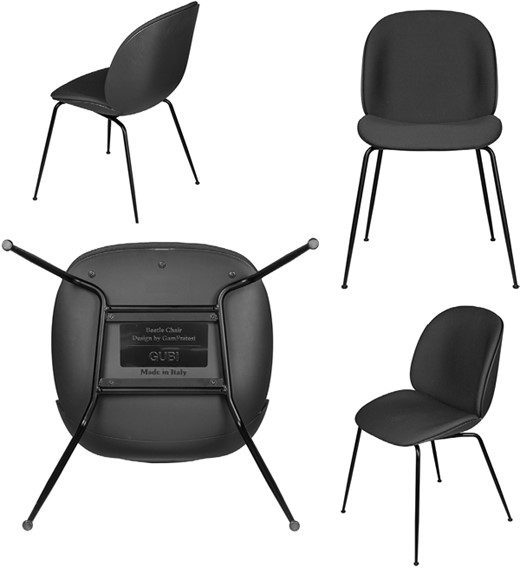
EUTM No. 018316101.
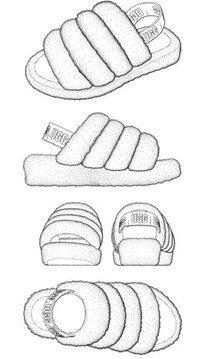
EUTM No. 018310011 and 017965836.
EUTM No. 017965836.
Again, we might query whether consumers will recognise the shapes of such products as origin indications, rather than as fashionable or aesthetically pleasing, etc. Presumably, the shape marks illustrated have been accepted based upon CP9, since the product shape is combined with a word or device mark, and substantial value has not been raised, despite the inherently attractive nature of these products.
Traditionally, the way to protect product shapes such as these would be using design rights, including the EU-wide registered and unregistered community design schemes. The illustrated examples suggest that there may be a significant overlap with shape mark and design protection. While there is no rule against cumulative IPRs, or selecting one form of IPR over the other, this overlap does raise questions about the competitive impact of differing schemes of protection under trade mark and design law. These concerns may be particularly pronounced in relation to ‘pure’ shape marks. It is beyond the scope of this piece to establishing how many of these shape mark registrations were preceded by, or enjoy concurrent, design registrations.[90] Without further study we may only speculate whether applicants are seeking trade mark protection because these particular shapes function as both trade marks and designs, or because the trade mark regime provides them with broader, longer-lasting rights, because of some issue with the design system, because, or simply to gain competitive advantage from both forms of protection.[91]
7. Conclusion: Putting It All Together: How Hard Is It to Register a Shape Mark at EUIPO? Should It Be harder?
This research has shown that the catalogue of ‘3D shape’ marks registered at EUIPO is a varied one. Moreover, practically all are registered based on inherent rather than acquired distinctiveness. The category spans product and packaging shapes, but also 3D shapes used in respect of services—an area that I have argued is worthy of further consideration to ensure that competitive concerns are properly protected.
In competition terms, it is concerning, in principle at least, that the functionality provisions contained in Art.7(1)(e)—designed to protect competition interests when shape marks are being considered for registration—are largely being bypassed during the EUIPO’s examination. In practice, the examination for distinctiveness is generally acting as an effective proxy for technical, but not ‘aesthetic’, functionality concerns, even though they are not being adumbrated explicitly. Indeed, as I have argued, there appears to be a possibly subconscious line of normativity running through the registration of shape marks, with the marks that potentially most harmful to competition being those which it is most difficult to register. Nonetheless, it remains the case, that it is possible to register a ‘pure’ product shape without resort acquired distinctiveness or to combination with other distinguishing non-3D features.
Competition concerns are being allayed by the fact that the majority of shape marks that are registered do include additional non-3D matter, mostly having trade mark significance in its own right. In many (but not all) cases, this should mean that such marks are not infringed by the use of a similar shape but without the non-3D material. This begs the question, what is it that the 3D aspect of these marks—which is often a completely non-distinctive shape of packaging—is adding to the mark, and how wide is the scope of protection for such marks?
Finally, trade mark registrations for product and packaging shapes appears, in some instances, to be used to supplement, or as an alternative to design protection for product configurations which lack independent trade mark significance. While it is true that such registrations often (but not always) feature the trade mark owner’s name or logo, it is unclear that this will always prevent such marks from being enforced against third parties who are merely wanting to sell products having the same or similar shape. Although such users may be able to rely upon the defence that the matter they are using is not distinctive, it would need to be a determined defendant to stay the course to hammering these issues out through the defences, rather than capitulating at an earlier stage. Thus, it would appear that, in some instances, the registration of shape marks provides an alternative to design protection of unlimited duration.
-
A Kur, ‘Yellow Dictionaries, Red Banking Services, Some Candies, and a Sitting Bunny: Protection of Color and Shape Marks from a German and European Perspective’ in I Calboli and M Senftleben (eds), The Protection of Non-Traditional Trademarks: Critical Perspectives (OUP 2018) 89 mentions Germany, Italy, Austria and Greece. It was also true in the UK, see: In re Coca-Cola Co. [1986] 1 WLR 693 and also R Burrell and H Beverley Smith, ‘Shaving the Trade Marks Directive down to Size?’ (2000) 63(4) MLR 570, 570 and sources cited therein (Report of the Departmental Committee on the Law and Practice Relating to Trade Marks (Goschen Committee) Cmd 4568 (London: HMSO 1934) [13]; In re James’ Trade Mark (1886) 33 Ch. D 392). ↑
-
Art.3, Directive (EU) 2015/2436 of the European Parliament and of the Council of 16 December 2015 to approximate the laws of the Member States relating to trade marks (Recast) (‘TMD’); Art.4, Regulation (EU) 2017/1001 of the European Parliament and of the Council of 14 June 2017 on the European Union trade mark (codification), (EUTMR) and predecessors. ↑
-
Case C-299/99, Koninklijke Philips Electronics NV v Remington Consumer Products Ltd, EU:C:2002:377 (‘Philips’). ↑
-
A trade mark registration is granted for an initial 10-year term, but this period can be extended by renewal every 10 years for as long as the owner desires, although the registration becomes open to challenge if the mark is no longer being used. ↑
-
On overlapping IP rights generally, see M Senftleben, ‘Overprotection and Protection Overlaps in Intellectual Property Law – the Need for Horizontal Fair Use Defences’ in A Kur and V Mizaras (eds), The Structure of Intellectual Property Law: Can One Size Fit All? (Edward Elgar 2011); E Derclaye, ‘Overlapping Rights’ in R Dreyfuss and J Pila (eds), The Oxford Handbook of Intellectual Property Law (OUP 2018). ↑
-
Case C-383/99 P, Procter & Gamble Company v OHIM, EU:C:2001:461, [40]. ↑
-
Case C-218/01 P, Henkel KGaA v Deutsches Patent- und Markenamt, EU:C:2004:88 (‘Henkel’), [49]–[52]. ↑
-
Discussed in, e.g.: U Suthersanen and M Mimler, ‘An Autonomous EU Functionality Doctrine for Shape Exclusions’ (2020) 69(6) GRUR International 567; A Quaedvlieg, ‘Shapes Which Give Substantial Value to the Goods: Towards a Systematic and Homogeneous Protection of Designs in the EU’ in Marie-Christine Janssens and Geertrui van Overwalle (eds), Harmonisation of European IP Law: From European Rules to Belgian Law and Practice: Contributions in Honour of Frank Gotzen (Bruylant/Larcier 2012); E Rosati, ‘The Absolute Ground for Refusal or Invalidity in Article 7(1)(e)(iii) EUTMR/4(1)(e)(iii) EUTMD: In Search of the Exclusion’s Own Substantial Value’ (2020) 15(2) Journal of Intellectual Property Law & Practice 103. ↑
-
Philips, [82]; Case C-48/09, Lego Juris v OHIM, EU:C:2010:516, [46]; Case C-205/13, Hauck GmbH & Co KG v Stokke A/S, EU:C:2014:2233, [19]. ↑
-
M Senftleben, ‘Signs Eligible for Trademark Protection in the European Union: Dysfunctional Incentives and a Functionality Dilemma’ in I Calboli and J Ginsburg (eds), Cambridge Handbook on International and Comparative Trademark Law (CUP 2020) 214. ↑
-
A Kur, ‘Too Common, Too Splendid or “Just Right”? Trade Mark Protection for Product Shapes in the Light of CJEU Case Law’ (2014) Max Planck Institute for Innovation and Competition Research Paper No 14-17, 26. ↑
-
‘Functionality in Europe: When Do Trademarks Achieve a Technical Result?’ (2020) 110(3) The Trademark Reporter 659; ‘Technical Functionality in European Trade Mark Law’ (2021) 137 Law Quarterly Review 113; ‘Consumer Value as the Key to Trade Mark Functionality’ (2022) 85(3) Modern Law Review 661; ‘Psychology, Prototypicality and Basic Shapes: The “Shape Resulting from the Nature of the Goods” Exclusion under EU Trade Mark Law’ in E Rosati and H Bosher (eds), Developments and Directions in Intellectual Property Law: 20 Years of the IPKat (OUP 2023). ↑
-
‘An Empirical Study of the Basis of Refusal of EU Trade Marks for 3D Marks’ in E Derclaye (ed.), Research Handbook in Empirical Intellectual Property (Edward Elgar 2023). ↑
-
B Beebe, ‘An Empirical Study of the Multifactor Tests for Trademark Infringement’ (2006) 94(6) California Law Review 1581. See also D Lim, ‘Trademark Confusion Revealed: An Empirical Analysis’ (2022) 71 Am UL Rev 1285. ↑
-
I Simon Fhima and C Denvir, ‘An Empirical Analysis of the Likelihood of Confusion Factors in European Trade Mark Law’ (2015) 46(3) IIC 310. See also L Anemaet, ‘The Fairy Tale of the Average Consumer: Why We Should Not Rely on the Real Consumer When Assessing the Likelihood of Confusion’ (2020) 69(10) GRUR International 1008. ↑
-
J Cornwell, ‘Playing by Its Own Rules? A Quantitative Empirical Analysis of Justificatory Legal Reasoning in the Registered Trade Mark Case Law of the European Court of Justice’ (2021) 46(5) European Law Review 647. ↑
-
B Beebe and J Fromer, ‘Are We Running Out of Trademarks? An Empirical Study of Trademark Depletion and Congestion’ (2018) 131(4) Harvard Law Review 945; B Beebe and J Fromer, ‘The Future of Trademarks in a Global Multilingual Economy: Evidence and Lessons from the European Union’ (2022) 112 The Trademark Reporter 902. ↑
-
G von Graeventiz, ‘Trade Mark Cluttering – Evidence from EU Enlargement’ (2013) 65(3) Oxford Economic Papers 721. ↑
-
C Castaldi, ‘The Economics and Management of Non-Traditional Trademarks: Why, How Much, What, and Who?’ in Calboli and Senftleben, Non-Traditional Trademarks (n 1) 227–70. ↑
-
M Adams and A Scardamaglia, ‘Non-Traditional Trademarks: An Empirical Study’ in Calboli and Senftleben, Non-Traditional Trademarks (n 1) 37–58. ↑
-
See n 12. ↑
-
<https://euipo.europa.eu/eSearch/#advanced/trademarks> accessed 31 July 2023. ↑
-
D Gangjee, ‘Paying the Price for Admission: Non-Traditional Marks Across Registration and Enforcement’ in Calboli and Senftleben, Non-Traditional Trademarks (n 1) 74. ↑
-
It might be possible to detect some such figurative marks by examining those figurative marks that have been subject to a functionality objection, as in Case C-337/12 P, Pi-Design AG v Yoshida Metal Industry Co. Ltd, EU:C:2014:129 (ostensibly a 2D dot pattern actually representing ‘non-slip’ dimples on a knife handle). However, this would not identify those marks that have fallen under the functionality radar – exactly the sort of marks we are trying to detect. Additionally, as will be seen later, functionality is in fact raised quite infrequently, even in relation to those marks which would arguably meet the criteria. ↑
-
For this analysis, the partial refusals have not been counted separately. They do not count as a separate filing, and without similarly coding ‘partial refusals’ for all EUTMs filed during the period, it would not be possible to make a like-for-like comparison. Thus, a mark was classified as ‘registered’ providing that it was accepted for registration for at least some goods/services designated. ↑
-
That is, at the date of harvesting the data, the validity of the registration had not been challenged. ↑
-
EUIPO Guidelines B.2.9.3.3. ↑
-
The registration of shapes for services has been the subject of scrutiny in the USA, focussing on whether shapes for services count as product configuration (requiring acquired distinctiveness) or product packaging (for which inherent distinctiveness is sufficient). The TTAB opted for the latter approach in In re Frankish Enterprises Ltd, 113 USPQ 2d 1964 (TTAB 2015) [precedential], following In re Chippendales USA, Inc., 96 USPQ 2d 1681 (Fed. Cir. 2010) [precedential]. For a recent application see In re Seminole Tribe of Florida, 2023 USPQ 2d 631 (TTAB 2023) [precedential]. The packaging/product distinction has itself been heavily criticised, see, e.g., G Dinwoodie, ‘Reconceptualizing the Inherent Distinctiveness of Product Design Trade Dress’ (1997) 75 NCL Rev 471, and it might be argued that classifying shapes used for services as packaging is an example of the collapse in distinction between the two categories that Dinwoodie argues for. ↑
-
The exclusions read as follows (emphasis added): ‘signs which consist exclusively of: (i) the shape, or another characteristic, which results from the nature of the goods themselves; (ii) the shape, or another characteristic, of goods which is necessary to obtain a technical result; (iii) the shape, or another characteristic, which gives substantial value to the goods’. I suggest below though how the provisions might be read (somewhat creatively) to include services. ↑
-
Case E-5/16, Municipality of Oslo v NIPO of 06/04/2017. ↑
-
EUIPO Guidelines B.4.6.1. ↑
-
This application was filed just before the studied period, but is included in the discussion (although not in the data set) because it is such a good illustration of how registrations for services can impact on competition. ↑
-
This mark includes the proprietor’s conventional word and device marks might avoid issues relating to third-party uses in respect of vehicles, but this does not help in relation to repair services, where the issue is intrabrand competition for the downstream market for repair. ↑
-
Or perhaps even the car itself, as the subject matter of the service, though there would be strong policy reasons for this not to be considered infringing based on exhaustion and sustainability. ↑
-
All the shop layouts registered contained distinctive non-3D matter, but layouts without additional matter could raise competition issues, see: CJ Ramirez-Montes, ‘Trade Marking the Look and Feel of Business Environments in Europe’ (2019) 25(1) Columbia Journal of European Law 75. ↑
-
Though note, the owner holds other EUTMs for the same shape registered for ‘vehicles’. ↑
-
Case T-629/14, Jaguar Land Rover Ltd v OHIM, EU:T:2015:878, [26]. ↑
-
Again, these numbers are based on the 2,024 separating filings made, rather than the 2,136 records that took account of partial refusals. ↑
-
The note sets out the common practice adopted by the EUIPO and Member State national offices regarding priority, relative grounds and genuine use pertaining to B&W and greyscale applications. Note that infringement is outside the scope of the common practice. ↑
-
Acceptance is subject to prominence and position of the additional non-3D matter. ↑
-
Put simply, this means that we would expect 95% of the results to fall within the result being hypothesised. Statisticians often choose 95% as the confidence interval, but 90% and 99% are also common. ↑
-
The Sig or ‘P– value’ is the probability that the null hypothesis is true and that the results obtained occurred by chance. A value of 0.05 or lower indicates that there is a 5% chance or less that the null hypothesis is true and so that the hypothesised relationship is inaccurate and is the conventional measure of significance used. P-value is affected by both the strength of the association between variables (i.e. the hypothesis being true) and sample size. Given the low numbers for some types of marks, the P-values in this study were, unfortunately, frequently well above 0.05. ↑
-
N.B., these factors do not exist in isolation, and any one mark will embody a range of these factors, all of which contribute to the ultimate outcome regarding registration. ↑
-
Even higher registration rates for logos, services and ‘Other’. ↑
-
B&W product marks with non-3D matter and B&W packaging marks with non-3D matter, each accounting for approx. 12% of the total number of registered shape marks. ↑
-
Although, as noted below, it is likely that such academic comments were directed particularly at ‘pure’ shape marks, rather than those with other, non-3D material. Nonetheless, my study also shows that a significant number of those ‘pure’ shape marks have also been registered. ↑
-
See: <https://decomed.it/homeeng#decomed-en> accessed 31 July 2023. ↑
-
A further example of this phenomenon is that the EUIPO has, perhaps unknowingly registered as shape marks the images of semi-famous people or characters, see in particular EUTM No. 018148608 the image of what looks like a mug but is in fact the mask worn by DJ Marshmallo and EUTM No. 018594683, the image of a man dressed in black who, on further examination via the Google Image Search turns out to be motorcycle racer Kae de Wolff. These registrations were made without objection or consideration of the fact that arguably this creates a form of personality right. The need for examiners to investigate the context of use of the sign to understand the ‘true’ nature of the mark was discussed in Case C-337/12 P, Pi-Design AG v Yoshida Metal Industry Co. Ltd, EU:C:2014:129, see n 24, above. ↑
-
Note, the file histories were missing from 11 cases which were ultimately refused. The EUIPO added these subsequently, at the author’s request, for seven of these files, but after processing cut-off point. Thus, the outcomes in these files were not added to the data set, as it was possible that other files which appeared to be complete may also have had information added which I would not have had an opportunity to identify. However, the outcomes for these cases will be included in the text/footnotes as appropriate. ↑
-
Also in all seven of the ‘missing’ decisions. ↑
-
Also in one of the missing file history cases. ↑
-
Also in one of the missing file history cases. ↑
-
See Kur, ‘Too Common’ (n 11) 5–6. ↑
-
See Section 1.A, above. ↑
-
I view this is an adverse outcome because generally the refused element will be for the goods the applicant is mostly likely to want to use the mark on, e.g. the shape of a car for cars. In some instances though, the mark might be registered for allied goods, e.g. the shape of a car for a motorbike (as detailed below), leading to potentially strategic uses where there could be enforcement in relation to the very good for which the mark was refused. ↑
-
Indeed, the examiners’ decisions that would have led to a rejection, had the mark not been withdrawn, were visible on very many of the file histories. ↑
-
A rare exception involving two shape marks is Opposition B 003074072, concerning an application to register the shape of a mini-figure which was successful opposed by Lego, the proprietor of an earlier registration for a mini-figure. ↑
-
See also, EUTM Nos. 018042931, 018042934 and 018042936. ↑
-
Senftleben, ‘Dysfunctional Incentives’ (n 10); L Anemaet, ‘The Public Domain Is Under Pressure – Why We Should Not Rely on Empirical Data When Assessing Trademark Distinctiveness?’ (2016) 47 IIC 303, 304. ↑
-
Art.7(3) EUTMR. ↑
-
In some cases, the distinctiveness objection only relates to specific EU member states, where, e.g., text in the mark has a descriptive meaning in some EU languages, but not in others. ↑
-
Case C-84/17 P, Société des produits Nestlé SA v Mondelez UK Holdings & Services Ltd, EU:C:2018:596. ↑
-
L Porangaba, ‘Acquired Distinctiveness in the European Union: When Non-traditional Marks Meet a (Fragmented) Single Market’ (2019) 109(3) The Trademark Reporter 619. ↑
-
This figure is derived by searching EUIPO e-Search plus selecting marks registered based on acquired distinctiveness. ↑
-
The table includes all the UK domestic cases recorded as 3D marks, therefore excluding UK rights based on EUTMs at the end of the Brexit transition period (1 January 2021). Marks filed before April 2013 feature only if they were subsequently registered; information on applications which were refused/abandoned/opposed/expired was not migrated to the UKIPO’s current IT system. ↑
-
Whether this is acceptable under international law, compare Kur ‘Too Common’ (n 11) 28, with N Loon, ‘Absolute Bans on the Registration of Product Shape Marks: A Breach of International Law?’ in Calboli and Senftleben (n 1) 147–64. ↑
-
Art.4. EUTMR. ↑
-
Joined Cases C-53/01 to C-55/01, Linde AG, Winward Industrie Inc and Rado Uhren AG v Deutsches Patent- und Markenamt, EU:C:2003:206, [46]. ↑
-
Equally, it is arguably that the shape is adding substantial value to the goods, as the inhaler may be purchased because children will be attracted by its aesthetic appeal. For analogous arguments in a US decision, see: In re Organon N.V., 79 USPQ2d 1639 (TTAB 2006), where an orange flavour found functional for anti-depressants because patients were more likely to take the medication because of its pleasant taste. ↑
-
Secondary meaning is required for product configuration in the USA, but not for packaging – see Wal-Mart Stores, Inc. v Samara Bros. 529 U.S. 205 (2000). Requiring acquired distinctiveness more generally might also help to avoid the phenomenon identified above, whereby potentially functional or non-distinctive trade marks are registered because it is not clear to the examine how they will be used. ↑
-
Note, EUTMs for pure colour marks are only registered based on acquired distinctiveness, for competition-based reasons; see: Case C-104/01, Libertel Groep BV v Benelux-Merkenbureau, EU:C:2003:244. ↑
-
For an unsuccessful attempt to enforce an EUTM combining a product shape and distinctive word against sales of a similar product shape bearing a different word mark, see Whirlpool Corporation v Kenwood Ltd [2009] EWCA Civ 753. ↑
-
Case T-273/21, The Bazooka Companies v EUIPO, EU:T:2022:675, the overlapping elements were the teat of a baby bottle for sweets while the mark as used bore the arguably more distinctive term BIG BABY POP! In Case C-642/15 P, Klement v EUIPO, EU:C:2016:918, the mark as registered was the shape of an oven while the mark as used included the word KLEMENT. ↑
-
See, e.g., s.14, Trade Marks Act 1938. EU trade mark law, implemented as s.13 of Trade Marks Act 1994 permits voluntary disclaimers only. In a post-Brexit world, it could be possible, at least in the UK, to reintroduce them. ↑
-
See, e.g., Grounds for Refusal of 3/10/2019 for EUTM Nos. 018344950 and 017096181. ↑
-
Case C-292/00, Davidoff & Cie SA and Zino Davidoff SA v Gofkid Ltd, EU:C:2003:9. ↑
-
Case C-84/17 P, see n 62. ↑
-
See n 12. ↑
-
SkyKick UK Ltd v Sky Ltd, UKSC 2021/0181. ↑
-
Case C-529/07, Chocoladefabriken Lindt & Sprüngli AG v Franz Hauswirth GmbH, EU:C:2009:361. ↑
-
Case C-371/18, Sky plc v Skykick UK Limited, EU:C:2020:45. ↑
-
See n 12. Although I had identified this phenomenon previously, this was in relation to reasons why marks were refused registration, whereas this current research has gone further. By examining the entire population of shape marks filed, I have also captured data relating to the basis on which marks were withdrawn and cancelled, as well as cases where grounds for refusal were raised but ultimately rejected. This has underlined that lack of distinctiveness is the main objection which shape mark applications face. ↑
-
Case C-329/02 P, SAT.1 Satelliten Fernsehen GmbH v OHIM, EU:C:2004:532, [23]–[27]. ↑
-
Philips (n 3) [76]. ↑
-
CJ Ramírez-Montes, ‘Proving Inherent Distinctiveness of Trade Dress Marks: Does European Union Law Depart Significantly from the Norm? Part 1’ [2019] Intellectual Property Quarterly 224, 236 onwards. ↑
-
Case C-237/19, Gömböc Kutató, Szolgáltató és Kereskedelmi Kft. v Szellemi Tulajdon Nemzeti Hivatal, EU:C:2020:296, [46]; A Kur, ‘Too Pretty to Protect? Trade Mark Law and the Enigma of Aesthetic Functionality’ (2011) Max Planck Institute for Innovation & Competition Research Paper Series 11–16. ↑
-
The London Taxi Corporation Ltd v Fraser-Nash Research Ltd & another [2017] EWCA Civ 1729, [37]–[42]. ↑
-
G Dinwoodie, ‘Trademark Law as a Normative Project’ (2023); available at https://ssrn.com/abstract=4344834. ↑
-
While CP4 prevents black and white marks from counting as a claim to the mark in all colours at the examination stage, it does not cover infringement, which is a matter for national courts. It is also worth highlighting that the established practice (derived from registered design practice) that an application for a line drawing of a product (inevitably black and white) is considered as a claim for that shape in the abstract, i.e. not a claim to any particular colour. ↑
-
A spot check on the illustrated examples revealed that none had corresponding RCDs covering the basic product shape. For EUTM 017965836, although the sandal shape was not protected, somewhat ironically, RCD 005802642-0001 covers the shoe’s sole with the words REGINA SEDUCE ME in close up. ↑
-
For a more detailed evaluation, see, e.g., L Chave, ‘In Good Shape? A Comparative Evaluation of the Registration of 3D Product Forms as Trade Marks and Designs under EU Law’ (PhD thesis, University of Nottingham 2017). ↑
