
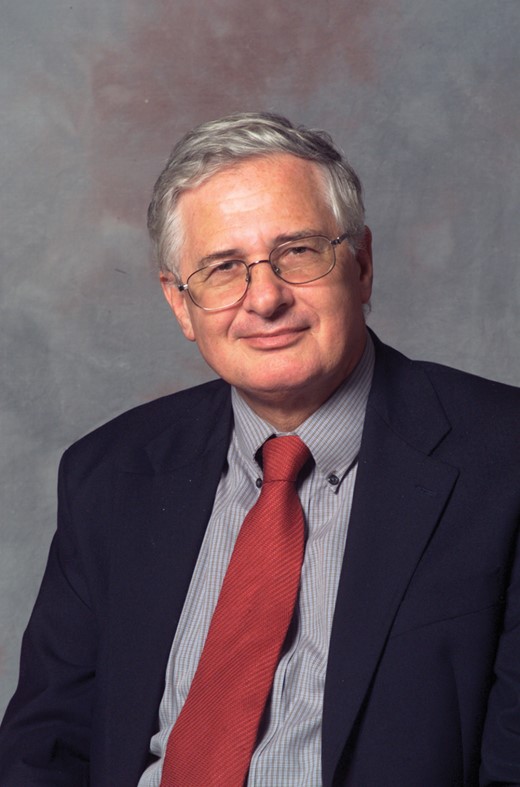
In Memoriam: Prof. Michael Freeman
Professor Michael Freeman, FBA (Emeritus Professor of English Law) was a world-renowned scholar in the fields of Family Law, Child Law and Policy, Children’s Rights, Medical Ethics and the Law and Jurisprudence and Legal Theory. He was particularly passionate about children’s rights and his pioneering work in this and his other fields set the stage for debates that continue to this day.
Michael’s connection with the UCL Faculty of Laws spans more than 60 years. It began in 1962 when he became a student in the LLB programme and continued when, after completing his LLB in 1965, he stayed on at UCL to read for his LLM. He then took a short break from UCL in 1966 to take up a lectureship at Leeds University where he remained for 3 years. Then, in 1969 Michael returned to UCL to teach Jurisprudence and Family Law where he remained for the rest of his academic career, all the while expanding his teaching, and publishing portfolio. He was elected Fellow of the British Academy in 2009. On his retirement in 2011, he became Emeritus Professor of English Law, and held that title until his death in 2024.
Over the course of his 55-year career at UCL, Michael’s energy, intellectual curiosity, and generosity were boundless. He published over 85 books and countless articles. He convened the faculty’s flagship Current Legal Problems series of lectures and edited the publications from 1993 to 2004. He founded and organized the Current Legal Issues series of colloquia which ran from 1998 to 2015. He was the Founding Editor of the International Journal of Children’s Rights ; Founding Editor of the International Journal of Law in Context , General Editor of the International Library of Medicine, Ethics and Law , and of the International Library of Family, Society and Law , and was editor for many years of the renowned Lloyd’s Introduction to Jurisprudence.[1] But Professor Freeman’s astonishing body of work did not end with his retirement. Among other things, in 2015 he delivered the prestigious Hamlyn Lectures which were published in 2020 as A Magna Carta for Children? Rethinking Children’s Rights.[2]
Generations of students at UCL will remember Michael’s inspiring teaching. It is no surprise that he won numerous teaching awards. When he retired, events were held at UCL and at the law offices of former students. Over one hundred people attended the UCL event alone and those who were unable to come sent heartfelt notes of appreciation. Looking through these and other cards and letters, we see thanks for his entertaining lectures, his continual support, and words such as ‘friendly’, ‘encouraging’, ‘inspiring’, ‘stimulating’, ‘patient’, and ‘memorable’ used to describe his teaching and supervision.
Other former students share their stories:
From Riz Mokal:
Mike Freeman’s Thursday morning undergraduate seminars in the Keeton Room in 1995-96 fizzed with energy. Insights from legal positivism and Dworkinian antipositivism, from natural law theory and feminist, sociological, and other critical legal studies, all were somehow caused to bubble up from the depths, leavened by drollness, and brought into conversation. We students felt able to take on the giants in the field, safe in the knowledge that our genial guide was himself a master – the 6th edition of Lloyd’s, published the previous year, was on every other desk – and had our backs.
Noam Peleg recalls:
I came to UCL to study children’s rights with Michael, after been inspired by his work for many years. Meeting someone that you admire can be rather intimidating, but Michael was nothing but a generous, caring and supportive teacher and mentor from the first time we talked. This first conversation led to many more, and after the Master’s, my PhD in children’s rights followed, with his dedicated supervision. Over the years he showed nothing but intellectual curiosity, being open to new ideas and, unlike some other established academics, happy to be challenged and for disagreements. Michael was always up for a good chat, and we spent many lunch times or after-work drinks together. It wasn’t always children’s rights that we talked about, but also the news, history, and from time to time, a piece of juicy faculty gossip. Michael was a mensch.
Another former student, Laura Devine said:
Michael Freeman was my favourite lecturer at UCL laws, where I studied from 1983-1986. In fact, he was everyone’s favourite lecturer. Entering Bentham House and meeting Professor Freeman simply changed my life. His intellect was both formidable and captivating. He was passionate about the law, society, and education. Frankly, I was intimidated by him as I was very conscious of being a 23-year-old mature student, from Scotland. Michael recognised my insecurities and so invited me to his office to explain what lay ahead in studying for an LLB at UCL. For me to sit down he had to remove and relocate numerous books, journals and research papers before reassuring me that if I studied hard, I would both graduate and flourish in the legal profession. In those twenty minutes or so I had not only entered his room but entered a world of charisma, warmth, intelligence and wit. On my graduation, Michael evolved from being my very much-admired lecturer to that of a friend. He was always a regular and welcome attendee at the annual UCL laws alumni summer party which my office hosts. This year’s party, with 50 alumni, was on Tuesday 25 June, eight days before he died, which Michael and his wife Vivien enthusiastically joined. Many of Michael’s former students were delighted to see him, and many more recent alumni, who had not had the privilege of being taught by Michael were keen to meet the legendary Professor Michael Freeman.
Michael’s extraordinary innovation and contribution to legal education and legal scholarship only tell part of the story, however. The other part is his warmth, generosity, and sense of mischief. Many, including former colleagues Myriam Hunter-Henin, Riz Mokal, and Jonathan Rogers recall, for example, Michael delivering his lectures dressed as Margaret Thatcher, complete with a handbag, on the day of her resignation. Riz Mokal also shares the following story:
A part-timer of a particular vintage brought a copy of the Daily Mail to the Keeton Room, went to the loo, and returned to find it in the bin. Mike and I had walked in while the item’s proprietor had been absent, Mike had asked around, and when no one owned up, the receptacle was duly fed. The reader was incandescent, Mike only decorously apologetic. As he said by way of explanation, the Mail had supported quite the wrong side in the 1930s. Michael did in fact buy the Mail for a while, because his daughter Hilary had an occasional health care column in it. True to principle, however, he would pay the full price whilst only actually taking the pages in question, leaving the grateful newsagent the rest of the paper to take home at the end of the day.
And who, other than Michael, would publish an article in 1991 highlighting the absurdity of the marital rape immunity entitled ‘But if you can’t rape your wife, whom can you rape?’?
Mentoring and supporting early and mid-career career scholars, not only at UCL but across the international academic community was also a fundamental part of who Michael was. He treated early career scholars as peers and was always available to read and discuss works in progress. He inspired students and scholars across the globe. In 2013 the Faculty of Laws convened a colloquium honouring him and his work entitled Current Legal Issues: ‘Law and Michael Freeman’ [3] to which more than 100 participants from 12 different countries came to hear papers from over 40 leading academics, lawyers, and senior judges inspired by Michael’s work.
Michael’s passion for the law and for social justice was profound. His faith was also important to him and his work in challenging the unfairness of the Jewish ‘get’ resulted in new legal ways to help the fate of women trapped in religious marriages.
Michael’s passion for cricket, music, and opera ran almost as deep as his sense of social justice. Indeed, he recalled to Laura Devine that during his law degree, he gave cricket as much attention and dedication as he did his law studies. Alison Diduck, a former colleague, recalls: ‘I remember the times he would pop by my office to talk about family law and identify, within 5-10 seconds, not only the piece of classical music playing on my radio but usually the orchestra and the conductor too.’ He was a ‘renaissance man’ in the real sense of the word but wore his knowledge lightly.
Michael was completely dedicated to UCL’s ethos, diversity, and role as an educator. As Myriam Hunter-Henin said,
It is impossible to put a label on Michael. He has been celebrated as a child law specialist and advocate, a feminist, a scholar in jurisprudence, a bioethics scholar, a law and religion expert, a family lawyer, a private international law scholar. He was indeed an expert in all these disciplines and has left writings that have changed the course in each of these areas. But he was never one to stick to one disciplinary outlook. His thinking was both erudite and down-to-earth, free of the constraints of the framing of current debates. His inspiration was not born out of one discipline but out of his own impressive general culture and thirst for equality.
For all of Michael’s achievements, for his dedication, indefatigable energy, warmth, feistiness, sense of mischief, and above all his integrity, UCL Laws and the international community of legal scholars have much to be grateful. Most of all, we, his UCL colleagues are grateful for his enormous generosity of spirit, time, and intellect. One of Michael’s favourite restaurants he told Myriam Hunter-Henin, was Mon plaisir. And, as she says, the pleasure and honour were all ours. As Laura Devine said of Michael, ‘Maya Angelou’s observation is a fitting epitaph: “I’ve learned that people will forget what you said, people will forget what you did, but people will never forget how you made them feel.”’
May his memory be a blessing.
- MDA Freeman (ed), (Sweet and Maxwell). ↑
- Michael Freeman, A Magna Carta for Children? Rethinking Children’s Rights (Cambridge University Press 2020). ↑
- A Diduck, N Peleg, and H Reece (eds), Law in Society: Reflections on Children, Family, Culture and Philosophy. Essays in Honour of Michael Freeman (Brill Nijhoff 2015). ↑
