Model law? Template legal culture and the global production of environmental law
Online-first printer-friendly version. See DOI (following publication) for version of record.
(2026) 79 Current Legal Problems
1. Introduction
Every act of legal drafting begins somewhere. The starting point is rarely a blank page. A government official asks a consultant to draw lessons from foreign legislation while ensuring that the resulting law appears entirely local. A law firm partner asks a junior associate to craft bespoke indemnification language by drawing on provisions used in prior deals. A litigator shapes a strategy for a new dispute around arguments that have succeeded before. Yet legal scholarship and legal analysis tend to focus on finished legal products rather than the starting points from which they are assembled: what law becomes rather than where it begins.
The legal forms that are available, visible and treated as authoritative shape what can be imagined, copied, adapted and ultimately enacted. They help define the horizons within which legal actors conceive of problems, solutions and possibilities. This article emerged from my attempt to trace those starting points through a study of the worldwide adoption of environmental impact assessment (EIA) legislation. What I expected to be a search for model laws ultimately became a search for something more elusive.
Lawyers routinely build from inherited texts and forms, yet legal culture tends to celebrate creativity and innovation while treating those inheritances as background. Templates make this tension visible. They are documents designed to be adapted and repurposed, functioning as starting points that carry legal language and meaning across contexts. Although legal scholarship more often refers to boilerplate, model laws or framework statutes, these labels point to a broader phenomenon. Template legal culture describes a mode of legal production in which authority is generated through the replication and adaptation of standardised legal architectures and forms. It is an entirely familiar element of legal practice, yet one that rarely features in law’s origin stories.
The global spread of EIA offers an opportunity to examine these dynamics close up. EIA is celebrated as a landmark example of what I have elsewhere labelled ‘contagious environmental lawmaking’.[1] It is a process for identifying, predicting and evaluating the environmental effects of proposed projects before decisions are made.[2] It has been described as ‘arguably the most widely adopted management tool across the world’,[3] as ‘one of the more successful policy innovations of the 20th Century’[4] and as a critical marker of ‘modern’ environmental law.[5] Yet the mechanisms through which EIA achieved this extraordinary global reach remain poorly understood. EIA’s significance extends beyond its own procedural architecture. It has functioned as one of the primary institutional channels through which environmental law has been produced, transmitted and legitimated globally over the past half century. To understand how EIA travelled is, in part, to understand how environmental law itself has been made.
I did not set out to study templates. Their importance became apparent as I tried to identify the model laws said to underpin EIA’s rapid incorporation into domestic legislation around the world. Despite new software tools, computational analysis and extensive primary source research, no single ‘model law’ could be identified. Rather than originating from a single authoritative source, many EIA statutes appear to be hybrid constructions assembled from a range of templates and examples.
What began as a search for the origins of EIA legislation ultimately becomes an inquiry into a more fundamental question: how law generates novelty from inherited forms. The pages that follow move from accounts of policy diffusion and legal transfer to the templates, fragments and drafting practices through which legal texts are assembled and circulated. At its heart, this is an account of what becomes visible when the search for linear origins fails. Shifting attention from model laws to the materials through which law travels reveals different mechanisms of legal change. To see legal forms as inherited is not simply to trace their origins. It is to examine how the defaults embedded within them continue to shape what law can readily see, know and imagine.
2. The story of environmental impact assessment’s global spread
Few, if any, environmental law innovations have travelled as widely as EIA.[6] Few have also attracted such sustained criticism for overpromising and underdelivering.[7] These observations may be linked. The features that enabled EIA’s near-universal adoption may also help explain why its practical effects have so often fallen short of its ambitions.
Procedure and big ideas are rarely thought to coexist. In EIA, however, they do. EIA emerged from efforts to embed environmental protection and public participation in economic and political decision-making.[8] Those ambitions were translated into a remarkably modular legal form: a sequence of procedural stages including screening, scoping, impact assessment, public participation, decision-making and monitoring. EIA travelled light. It asked for procedural commitment, not substantive consensus.[9]
The story of EIA’s birth and spread conventionally begins with the United States’ National Environmental Policy Act (NEPA) in 1969. NEPA combined an expansive environmental vision with a novel procedural mechanism. Its opening declaration committed the federal government to creating conditions under which ‘man and nature can exist in productive harmony’, while Section 102 required agencies to prepare detailed assessments of the environmental consequences of major federal actions.[10] Together, these provisions joined environmental ambition to administrative procedure in a form that would prove remarkably resilient.
From this point, legislated forms of EIA appeared in virtually every country in the world.[11] The details of that process remain surprisingly difficult to reconstruct. Accounts of influence and legal transfer frequently conflict, many of the relevant actors remain invisible, and EIA itself appears in a variety of institutional forms.[12] Yet beneath this diversity lies a striking degree of structural similarity. Across jurisdictions, EIA processes repeatedly conform to a common procedural architecture and a ‘similar generic form’,[13] built around recurring stages such as screening, scoping, impact assessment, public participation, decision-making and monitoring. This modular structure helps explain how EIA could travel across time, space and political context.
A. The conventional account
The conventional account begins with a simple observation: within 50 years of NEPA, legislated EIA had reached virtually every part of the world.[14] The speed and geographic breadth of that spread are easier to see than to describe.
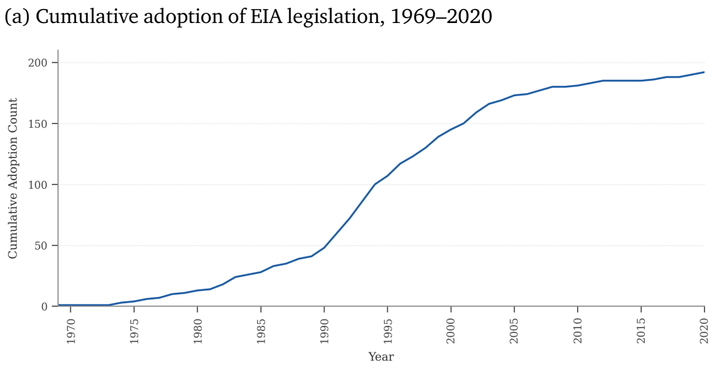
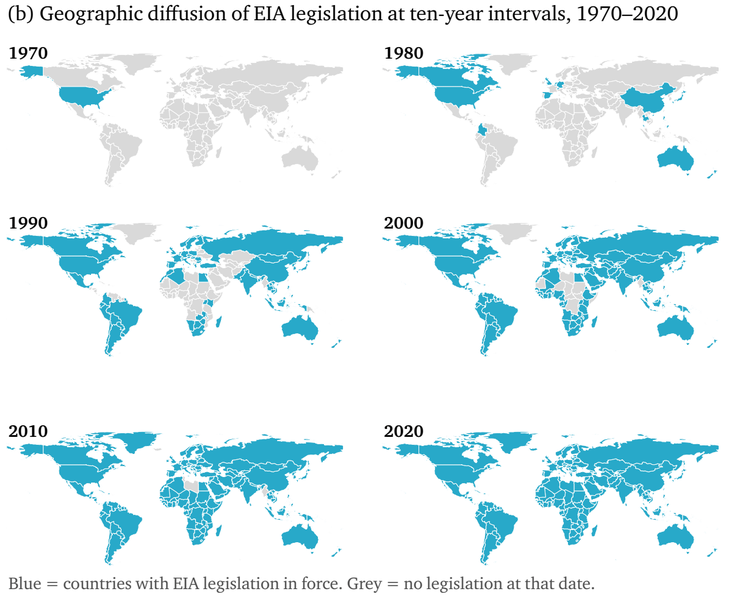
Figure 1: (a) Growth curve tracking adoption of national EIA legislation by year beginning in 1969, and (b) states with national EIA legislation (shaded in blue) by decade beginning in 1970. Source: author.
While there is much that the figure obscures,[15] it is a useful starting point in depicting the dominant account of EIA’s birth and global spread.[16] Three factors dominate explanations of EIA’s rapid global diffusion. First, the example of NEPA in the United States was undoubtedly influential. Second, international financial institutions played a pivotal role, alternately described as ‘sponsoring’ the development of EIA regimes or ‘coercing their adoption’, particularly in countries of the Global South.[17] And third, international and supra-national organisations and academic institutions spread EIA frameworks, expert knowledge and ‘best practices’, sometimes promoting them as universal standards rather than context-specific tools.[18]
These explanations typically place NEPA at the centre of the story. The enactment of NEPA in 1969 and its subsequent extension into American foreign policy, development assistance and international financial institutions are treated as pivotal moments in EIA’s diffusion.[19] This history is central to understanding EIA’s global spread, but it is not the whole story. Concerns about integrating environmental considerations into public decision-making were emerging simultaneously in a variety of national and international settings, reflected in initiatives such as the United Nations General Assembly’s adoption of Resolution 2398 in 1968 and preparations for the Stockholm Conference on the Human Environment. EIA’s emergence is therefore best understood not simply as the export of a single national innovation, but as one expression of a broader shift in environmental thought and governance.
Accounts of EIA’s global roll-out diverge in important respects. Some emphasise the independent attraction of EIA as a legal innovation, portraying its adoption as the result of voluntary adaptation by national legislatures.[20] Others place greater weight on the role of international organisations and development institutions, regional integration projects, and geopolitical transformation, including the coercive dimensions of aid and technical assistance. The European Union’s EIA Directive contributed to the adoption of EIA legislation across much of Europe,[21] while the World Bank increasingly embedded environmental assessment requirements within development finance. The dissolution of the Soviet Union in 1991 similarly contributed to the enactment of EIA legislation across many newly independent states.
Taken together, these histories point to a more complicated story of legal circulation than either voluntary adaptation or external imposition can capture. EIA’s spread was neither purely voluntary nor purely imposed. It was both, simultaneously.[22] Nor were receiving jurisdictions empty vessels. Their pre-existing traditions of environmental management, customary governance and nature protection[23] risk getting lost in accounts of EIA’s global spread. The blank-slate assumption that underlies many diffusion accounts obscures both the agency and existing legal imagination of the countries involved.
As Figure 1 demonstrates, the most intense period of EIA legislative adoption globally was in the 1990s. The United Nations Environmental Programme (UNEP) was active in seeking to implement EIAs from the time of the Rio Declaration (1992) onwards.[24] EIA enactment was perceived in this period as a mechanism to secure greater participation in international organisations.[25] The prospect of increased financial aid that came with EIA enactment became a force in its further spread.
Templates do not announce themselves as such. The underlying templates inspiring legislative forms were rarely model laws in the comparative law sense of the term.[26] A template for many of the EIA legal systems in the Global South[27] was a set of best practice principles developed by the International Association for Impact Assessment (IAIA) in 1999.[28] The IAIA Principles were employed by various actors, including the World Bank and UNEP, as the ‘starting point’ for efforts to develop EIA legislation.[29] They were drawn up with the explicit goal of articulating international standards and drew upon a series of studies on the effectiveness of EIA approaches in ‘western democratic countries’, on UNEP’s training manual, and on the expertise of IAIA members.[30]
Although not drafted as model legislation, the IAIA Principles effectively operated as a template for evaluating EIA systems. By codifying widely adopted criteria of effectiveness and ‘best practice’,[31] they created a reference framework that circulated through policy guidance, workshops, and the transnational work of consultants. Their template function becomes visible when one traces the repeated citations to the IAIA Principles in secondary literature describing legislative reform across multiple jurisdictions.[32] Critics have challenged the standardising logic of this approach, arguing that EIA legislation should begin with ‘country-specific context’ rather than a global model.[33] And yet, growing awareness of what universal models cannot capture[34] has done little to loosen the grip of templates.
B. Law, legal spread, and the narrative of implementation failure
It makes sense to pause for a moment here to highlight how law and legislation featured, or failed to feature, in these narratives of EIA’s diffusion. The study of EIA’s global spread has largely been defined by those working outside environmental law – comparative lawyers, constructivist international relations scholars, and sociologists. The voices of environmental law practitioners and scholars, themselves legal entrepreneurs in the diffusion of environmental law ideas and technologies, have been largely absent from these debates.
This is understandable, partly because the processes of diffusion at work ill-fit law’s fidelity to the transplant metaphor.[35] The complex and multi-pronged processes of transnational borrowing and environmental law diffusion at work in EIA’s global spread defy the singular and one-off model of the transplant. Perhaps due to the dominance of disciplines other than law in describing environmental policy much of the EIA literature has paid limited attention to the significance of EIA legislation and its emergence in a country, focusing instead on policy implementation and outcomes. And, yet, the various iterations of globally accepted EIA best practice all include ‘a strong legislative foundation’ as an element.[36]
At the same time as EIA legislation was snowballing globally, a narrative of EIA implementation failure was growing at an equally robust pace.[37] This led sociologists Ann Hironaka and her co-authors to suggest that many states were adopting EIA as a quick method for gaining prestige and improving their environmental reputations, with few real costs attached.[38] In their view, the procedural nature of EIA allowed its legislative enactment to be decoupled from its actual implementation.[39] This view fits well with the observed realities that EIA in many places was, and is, in practice ‘marginalized, of poor quality, elitist or technocratic, initiated too late, manipulated by vested interests, or largely ignored in the development planning decision-making structure’.[40]
An interesting contention from Hironaka and Schofer’s work is that ‘packages’ of EIA form legislation and standardised guidelines were available from international organisations that countries could download quickly and easily without making any real change on the ground. This led to wide adoption as states were receptive to this cost-saving alternative to developing their own EIA regimes.[41] Intrigued by Hironaka and Schofer’s claim, we set out to find the texts of these original templates.[42] This involved following up on a hunch that maybe ‘failed implementation’ might have something to do with the legislation itself.[43]
3. The search for missing models
This project begins from a deceptively simple question that has received less attention than the institutions and actors associated with diffusion: what exactly was circulating? If EIA travelled around the world, what was it that moved? Was it a broad idea, an administrative process, a set of professional practices, a legal model or something more specific? By focusing on statutory texts and their constituent provisions, this study seeks to illuminate the legal forms and templates that accompanied EIA’s remarkable global expansion.
It is not possible to examine the global spread of EIA without acknowledging the colonial and neocolonial contexts within which many environmental laws emerged. In numerous countries, the adoption of EIA was shaped by a complex mix of international influence, technical assistance, development finance and normative pressure. International conferences such as the 1972 Stockholm Conference and the 1992 Rio Conference helped establish EIA as a hallmark of modern environmental governance, while organisations including UNEP, the OECD, the World Bank and development banks promoted its adoption through guidance, capacity-building initiatives and lending practices.
Assertions abound regarding the origins and influences underlying particular EIA regimes. Brazil’s adoption of EIA, for example, has been attributed to the demands of international financing agencies.[44] Lebanon’s EIA legislation is often linked to the influence of international donors, including a World Bank-funded initiative.[45] USAID has conditioned certain forms of foreign assistance on the incorporation of EIA requirements,[46] while Fiji’s EIA system has been described as ‘developer and consultant pushed’.[47]
Claims of this kind extend to the influence of particular national legal models. Papua New Guinea’s assessment procedures have been described as deriving from Australian practice.[48] The Philippines’ EIA guidelines are said to closely reflect EIA approaches developed in the United States, particularly those associated with the US Council on Environmental Quality.[49] Malaysia’s system has been linked to Canadian influences,[50] while Yemen’s legislation has been described as drawing on both Dutch and Canadian models.[51] Yet the evidentiary basis for such claims is often difficult to establish. Assertions that legislation was ‘modelled on’, ‘influenced by’, or ‘derived from’ particular foreign systems frequently rest on the recollections of participants or secondary accounts, rather than on the documentary record of what was actually borrowed – a gap that reflects the invisible and informal nature of the drafting processes involved rather than any insufficiency of scholarly effort.[52]
This observation led to an intriguing research challenge: to locate the actual legal artefacts through which such influence may have been expressed. If EIA travelled globally, what exactly travelled with it? Was it possible to identify the specific models, templates or statutory forms that were shared, adapted or imposed between 1969 and 2020? Could I locate the ‘prepackaged laws’ referenced by Ann Hironaka and Evan Schofer? Was there a discernible ‘model’ of EIA that circulated through the Pacific Basin and Southeast Asia?[53] What were the ‘methods that are globally famous’ said to have shaped Slovakia’s legislation?[54] At this point, it was impossible to know that the search would prove most illuminating through its failures.
A. Shifting methods
Efforts to answer these research questions meant that I kept bumping up against the challenges of dealing with a data set as large and complex as ‘the global’.[55] The project encountered setbacks arising from the use of common terminology across very different legal and political contexts. The scale of the undertaking soon exceeded what could realistically be achieved through conventional methods of legal analysis.
It was time to change tack and pursue a different method for tracing EIA’s global movements through legislation. If diffusion claims could not reveal what had travelled, perhaps the legislation itself could. The challenge was to read across a vast corpus of legislation closely enough to identify recurring provisions and textual traces of inheritance.[56] This is where Daniel entered the story. Trained as a software engineer, he approached the problem through a different lens. Where I saw a frustrating failure to find things, he saw a problem to be solved. His proposal was simple but ambitious: to develop textual similarity software that could harness computational methods to trace the movement of legal language across statutes, jurisdictions and time.
Due in part to my inexperience with computational methods, I agreed. The allure of rich data sets, of confident and concrete findings, and of causal connections supported by high-powered statistical analysis was difficult to resist.[57] What I failed to anticipate were the costs of such methods. Preparing legislation for computational comparison proved extraordinarily time-consuming and cumbersome, particularly where digital copies were riddled with imperfections that introduced errors during text extraction. The algorithm employed, comparison of bigram frequency vectors, did not compensate for such errors. The text therefore had to be painstakingly cleaned before meaningful similarity measures could be generated.
Developing software to ingest legislative text, perform comparisons and generate the desired outputs was itself a substantial undertaking. One advantage of computer-assisted methods, however, is that they make each stage of the analysis more transparent. Decisions about data preparation, analytical tools and methodological choices are made deliberately and can be documented in ways that have few parallels in conventional legal research.[58]
Computer-assisted methods also encourage a different way of thinking about legislation: as a historical artefact, a textual record of choices made and alternatives foreclosed. The section that follows, which analyses the textual similarity of the initial legislation introducing EIA requirements in Francophone African countries, illustrates how such methods can surface new questions and open up new ways of understanding law and its circulation.
B. A case study: the textual similarity of EIA legislation in Francophone African countries
The computational analysis did not deliver what we expected. We went looking for model laws and found something more elusive: a modular legal architecture that resists reduction to any single origin. One of the most significant lessons of this process was the importance of starting points. What we were able to see was shaped by where, and how, we chose to look. Responsibility for those choices could not be shifted onto the machine. This is worth emphasising given prevailing concerns that computational methods displace human judgement. If anything, they made our own practices of inclusion and exclusion more visible. By directing attention towards the textual building blocks of legislation rather than treating EIA laws as indivisible wholes, the analysis revealed patterns of repetition, adaptation and recombination that would otherwise have remained hidden.
The importance of starting points became evident in the construction of the data set itself.[59] Conscious of the tendency to privilege Europe and North America in studies of legal diffusion, and of the dominance of English-language materials in comparative legal research,[60] the analysis began not from the default starting points that frequently structure accounts of legal diffusion, but from African legislation. Initial attention focused on Francophone countries before extending to Anglophone jurisdictions and legislation in Portuguese and Spanish (the latter two in translation).[61]
This article draws on our analysis of legislation from Francophone African countries.[62]
(i) Full-text and provision-level textual similarity analysis
Measuring textual similarity at the full-text level was the first of two analytical stages. While this approach did not yield definitive answers about legislative origins, it prompted a more productive set of questions. Figure 2 presents the results of a full-text analysis of the initial EIA legislation in the listed countries using bigram frequency, a metric that generates a quantifiable measure of lexical similarity.[63] The resulting heat map highlights patterns that warranted further investigation: for example, as shown in Figure 2, Chad and Cameroon exhibit a high degree of similarity, while Madagascar appears relatively distinct from the other countries.
Full-text analysis of this kind reveals the overall degree of lexical similarity between complete statutes, but cannot tell us where within each statute that shared language is concentrated, or whether it clusters in particular provisions or is diffused throughout the text. Provision-level analysis makes that question answerable, allowing specific clauses to be isolated, compared and traced across jurisdictions.
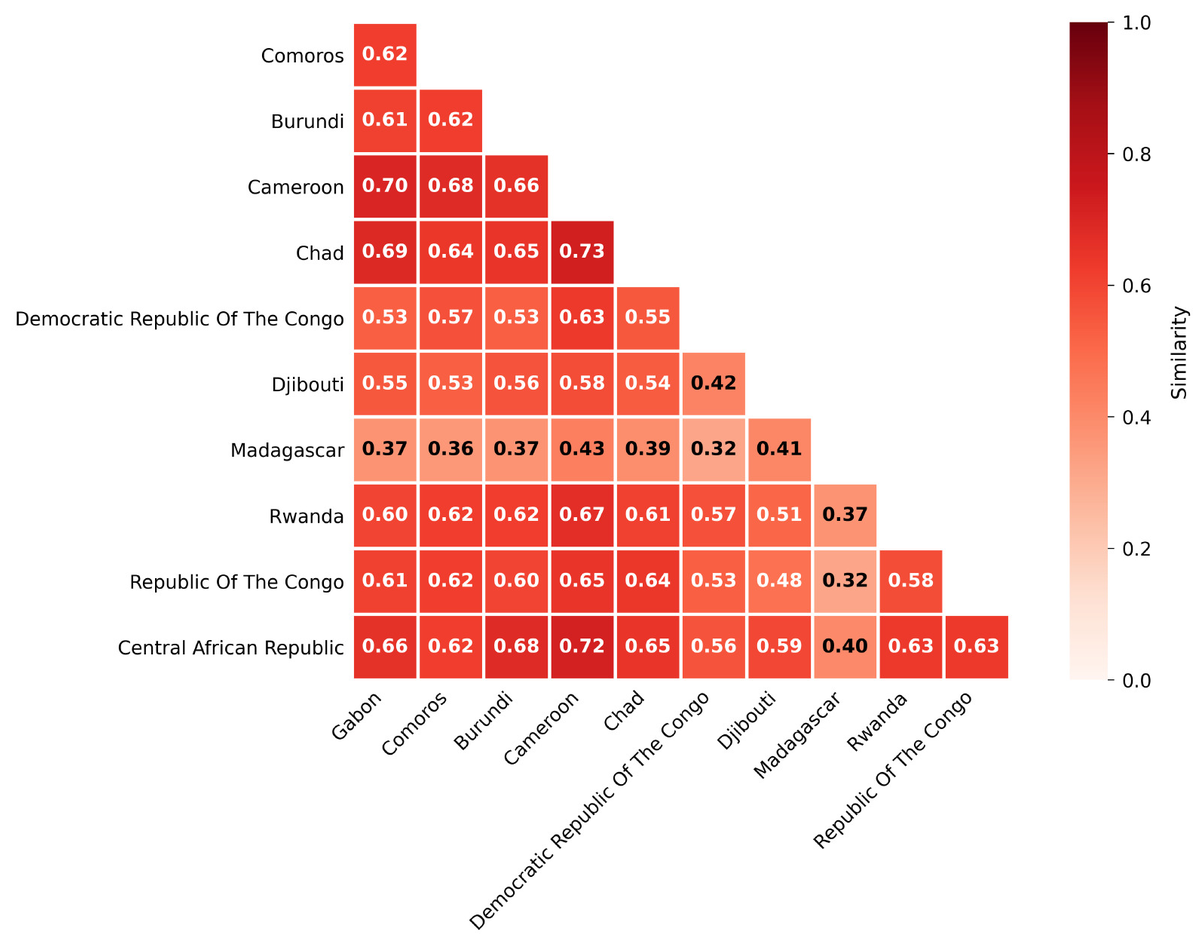 Figure 2: Francophone EIA legislation in Central Africa analysed using bigram frequency similarity (full text with provision delimiters). The heatmap shows pairwise lexical similarity scores between national statutes. Full text indicates that the complete legislative texts were analysed, provision delimiters indicates that subsection numbers, article markers and other structural divisions were retained. Darker cells indicate higher similarity (0–1). Source: author.
Although our initial questions focused on similarity, the method proved equally valuable in revealing difference. Difference is not merely residual variation around a common model. It points towards alternative histories of legal assembly that would have remained invisible had the analysis focused exclusively on tracing influence. In particular, this approach drew attention to outliers, jurisdictions whose texts diverge from dominant patterns and may reflect more locally specific trajectories of legislative development.
Madagascar’s divergence from the other statutes in the corpus illustrates the kind of inquiry that textual similarity analysis can open up without being able to resolve. The computational finding prompts a question – why is this statute so dissimilar – that only historical and contextual research can answer. Several converging explanations emerged. The most significant is structural: Madagascar’s 1990 law is a charte rather than a code de l’environnement, a framework of general rules and guiding principles rather than a compilation of operational provisions. With only 13 articles in the main law and EIA delegated entirely to subsequent decree, it simply contains too little text to share drafting material with the fuller environmental codes enacted by other Francophone African states.
Equally important was timing. Enacted two years before the Rio Summit and anchored in the goals of the Stockholm Conference of 1972, the Malagasy charter predates the post-Rio moment when UNEP, the World Bank and the IAIA began actively circulating the templates and best practice frameworks that shaped the other statutes in this corpus. The driving force behind the charter was not EIA standardisation but Madagascar’s unique biodiversity. The focus of institutional actors, including the World Bank, USAID and international conservation organisations, was thus biodiversity protection rather than the diffusion of environmental assessment procedure.[64]
Finally, the charter was enacted at a moment of political crisis, at the end of President Didier Ratsiraka’s long socialist second republic, in conditions of relative political isolation from the Francophone African mainstream.[65] Each of these factors is invisible to the similarity algorithm, which can only register that Madagascar’s text does not look like the others. Legislative form, timing, institutional influence and political context leave no trace in a lexical comparison. The computational finding thus functions less as an answer than as a prompt: it surfaces an outlier and directs attention towards the historical and contextual factors that might account for it.
Quantitative similarity measures reveal patterns; understanding what those patterns mean requires reading the provisions themselves. Figure 3 documents this process, probing pairs of provisions from countries with the highest similarity scores, such as Cameroon and the Central African Republic, to identify prototypical clauses and textual fragments replicated across statutes. Numerical similarity scores carry an inherent limitation, however: provisions can share many of the same words while conveying different meanings, and only scores approaching near identity resolve the ambiguity unaided. We therefore manually reviewed the provisions flagged as highly similar – revealing a pattern that is both informative and incomplete.
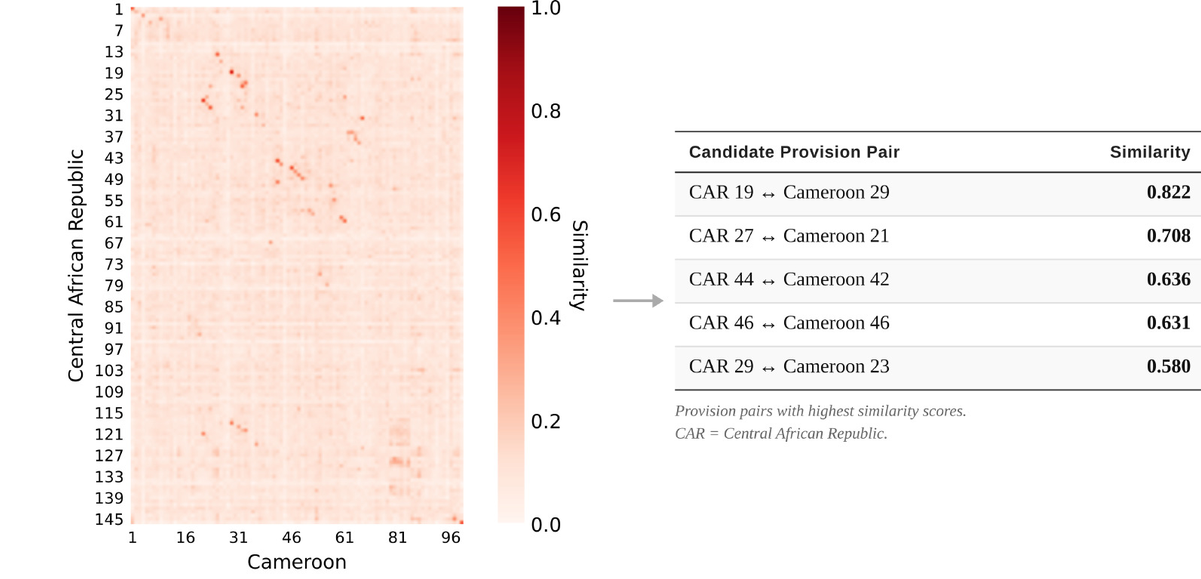 Figure 3: Tracing similarity from computation to text. The heatmap visualises pairwise similarity scores between provisions in the environmental legislation of the Central African Republic and Cameroon, indexed by provision number along each axis. Darker cells indicate higher lexical similarity. The texts of the highest-scoring provision pairs were then examined manually, enabling the identification of recurring provisions and shared legal language. Source: author.
What the heatmap makes immediately visible is the sparseness of strong similarity across the matrix as a whole. The overwhelming majority of provision pairs between the Central African Republic and Cameroon show low lexical similarity, visible in the pale background of the heatmap, with only a small number of darker cells scattered across the grid. This pattern is itself significant. It suggests that legislative borrowing between these two jurisdictions, if it occurred, was selective rather than wholesale: particular provisions were shared while the surrounding legislative architecture diverged.
Equally notable is that the darker cells do not cluster neatly along the diagonal, which would indicate sequential borrowing from provision to provision. Instead, they appear at scattered coordinates, consistent with the hypothesis that individual provisions were extracted from their original context and inserted into different sections of the receiving statute. The matrix does not tell us whether this occurred, or by what mechanism. But it narrows the field of inquiry and directs attention towards the specific provision pairs most likely to reward closer textual examination – precisely the role that computational methods are well suited to play.
(ii) ‘Most likely influencer’ analysis
Following the legislation-level and provision-level similarity analyses, network diagrams were then constructed to visualise relationships among national EIA statutes and identify potential sources of legislative influence. The expectation was that these visualisations might reveal clusters of related legislation or trace pathways through which legal texts had travelled. In practice, they functioned better as an internal research tool than as a means of establishing clear patterns of influence. A directed edge could indicate that one statute was enacted before another and that their provisions share measurable textual similarity, but not that one legislature read, borrowed from, or was aware of the other.[66]
Examining the provisions themselves nevertheless revealed recurring overlaps between pairs of countries that gave those suggestions a more concrete form. Guinea’s legislation proved particularly striking. Provision-level analysis revealed three distinct textual inheritances within a single statute: one provision identical to a provision in Cameroon, another identical to a provision in Burundi, and a third showing exceptionally high similarity with the Democratic Republic of Congo – each appearing in a different section of the legislation. No single source explains the statute’s composition. Guinea’s legislation appears to be assembled simultaneously from at least three distinct legislative lineages, making it one of the clearest illustrations in this corpus of how legal bricolage operates in practice. Similar patterns emerged elsewhere: provisions could be isolated that were shared between Algeria and Mauritania, Algeria and Togo, and Algeria and Senegal. These patchwork patterns brought the underlying templates into view, not as complete legislative models, but as modular fragments capable of circulating independently and being recombined in new ways.
The significance of these overlaps lies not in identifying who copied whom but in demonstrating that the search for singular origins is misplaced. Rather than wholesale transfer, the evidence points to hybrid legislation assembled from fragments of provisions drawn from multiple jurisdictions to complete or revise an underlying template.[67] The modularity of this process is visible in the language of the provisions themselves. Consider the following excerpt from India’s Environmental Impact Assessment Notification 1994:
Any person who desires to undertake any new project or the expansion or modernisation of any existing industry or project listed in Schedule I shall submit an application … accompanied by a project report which shall, inter alia, include an Environmental Impact Assessment Report/Environment Management Plan …
Schedule I: List of Projects Requiring Environmental Clearance …[68]
Stripped of jurisdiction-specific references, little in this language identifies it as uniquely Indian. The provision consists largely of portable regulatory components: a requirement for prior approval, a designated authority, a prescribed application process, an environmental assessment report, and a schedule listing covered projects. Such provisions can be inserted, modified, translated and recombined with relative ease, making them particularly effective vehicles for the circulation of legal templates.
The concept of bricolage offers a useful lens through which to understand how templates are operating.[69] Drawing on the work of Claude Lévi-Strauss, bricolage describes the process of constructing new arrangements from materials already at hand rather than designing institutions de novo.[70] The concept has since travelled into institutional theory, where it describes processes of incremental change through layering and recombination rather than wholesale replacement, and into socio-legal scholarship, where it illuminates how legal and governance frameworks are assembled from heterogeneous and sometimes incompatible materials.[71] The present use is narrower and more literal: it describes the textual recombination of discrete legislative fragments into new statutory formulations, a pattern identified through computational analysis rather than ethnographic methods.
This computational vantage point sits alongside scholarship that has reached similar conclusions by different routes. Annelise Riles, working ethnographically, has shown that the form of international legal instruments is not merely a vessel for legal content but is itself the medium through which legal actors produce and reproduce international order. The modular language, parallel structures and repeating textual components of legal texts are not incidental features. Form, for Riles, is where the work of law actually happens.[72] Katharina Pistor, writing from the intersection of law and political economy, has shown how modular legal building blocks encode and transmit particular visions of economic power across jurisdictions.[73] Where Riles reveals the mechanics of legal form from the inside and Pistor traces the distributional consequences of legal modularity, the computational analysis offered here makes the patterns of textual recombination visible across a body of instruments too large and dispersed to be grasped through close reading alone.
In the context of environmental assessment legislation, bricolage suggests that lawmakers assemble statutes from a repertoire of circulating legal modules, including model laws, donor requirements, international guidelines, professional standards and pre-existing domestic provisions. This perspective helps explain a central finding of this study: environmental assessment laws around the world exhibit striking textual and structural similarities, yet rarely converge on a single uniform model. Templates, in this account, are best understood not as blueprints for replication but as building blocks in an ongoing process of transnational legal bricolage.
C. A more granular look at templates in action: what is ‘the environment’?
The definition of ‘the environment’ offers a case study in how this process operates at the level of language itself. The similarity of definitional language was striking, particularly because the statutes in question were enacted across different legal traditions, languages and decades. The recurrence of near-identical formulations suggested that these definitions functioned as carrier provisions: stable enough to be recognised across jurisdictions, adaptable enough to survive translation.
Closer analysis revealed a common pattern. Drawing on both the English-language and French-language collections of African legislation, we were able to identify a base template, a starting point for the definition, along with recurring edits that combined distinct building blocks of text. The English-language definitions appear to trace back to the Environmental Protection Act 1970 of the state of Victoria in Australia, which defines the environment as: ‘the physical factors of the surroundings of human beings including the land, waters, atmosphere, climate, sound, odours, tastes, the biological factors of animals and plants and the social factor of aesthetics.’[74]
Common elements of the French, Spanish and Portuguese definitions appear to derive from an environmental vocabulary approved by the International Council of the French Language in 1970: ‘[l’environnement] désigne l’ensemble, à un moment donné, des agents physiques, chimiques et biologiques, et des facteurs sociaux susceptibles d’avoir un effet direct ou indirect, immédiat ou à terme, sur les organismes vivants et les activités humaines.’[75]
The coincidence of date is itself notable. Both texts were produced in 1970, the year that also saw the creation of the United States Environmental Protection Agency, the establishment of an OECD Environment Committee, and the beginning of preparations for the Stockholm Conference on the Human Environment. Neither was drafted as a template for global legislative adoption: the Victorian definition was a provision in a state-level pollution control statute; the French vocabulary was a terminological exercise by a linguistic body. Yet both achieved a remarkable reach, shaping how legislatures across different legal traditions and continents would answer a fundamental question in environmental law: what is the environment? Two texts produced independently in 1970 became the foundational building blocks for environmental definitions across much of Africa and, the evidence suggests, far beyond. This pattern sits at the edge of what existing accounts of legal diffusion are designed to see.
Comparing the two definitions also reveals that what travelled was not a single vision of the environment but two subtly different ones. The Victorian definition is anthropocentric and sensory. It places human beings at the centre, defining environment as the physical and biological factors of their surroundings, and includes among those factors experiential qualities: sound, odours, tastes, aesthetics. The French definition is functional and causal. Rather than defining environment as surroundings, it defines it as agents and factors capable of having an effect on living organisms and human activities – direct or indirect, immediate or deferred.
The difference has practical consequences. A definition centred on surroundings invites courts and regulators to ask: what is in the vicinity of human beings, and has it been degraded? A definition centred on agents and effects invites a different question: what is acting upon living organisms, and with what consequences? The first points towards place; the second towards mechanism. Statutes that inherited the Victorian definition tend to frame environmental harm spatially; those that inherited the French definition tend to frame it causally. The choice of template, made in 1970 for entirely local purposes, had consequences that extended far beyond anything its authors could have anticipated.[76]
The definitions in the legislation we reviewed did not simply replicate these formulations. Instead, they reveal a building-block approach in which elements of those definitions were broken into component parts and recombined to produce new formulations. Figure 4 presents a visualisation of this process, showing how fragments of legal text were assembled to construct new definitions.
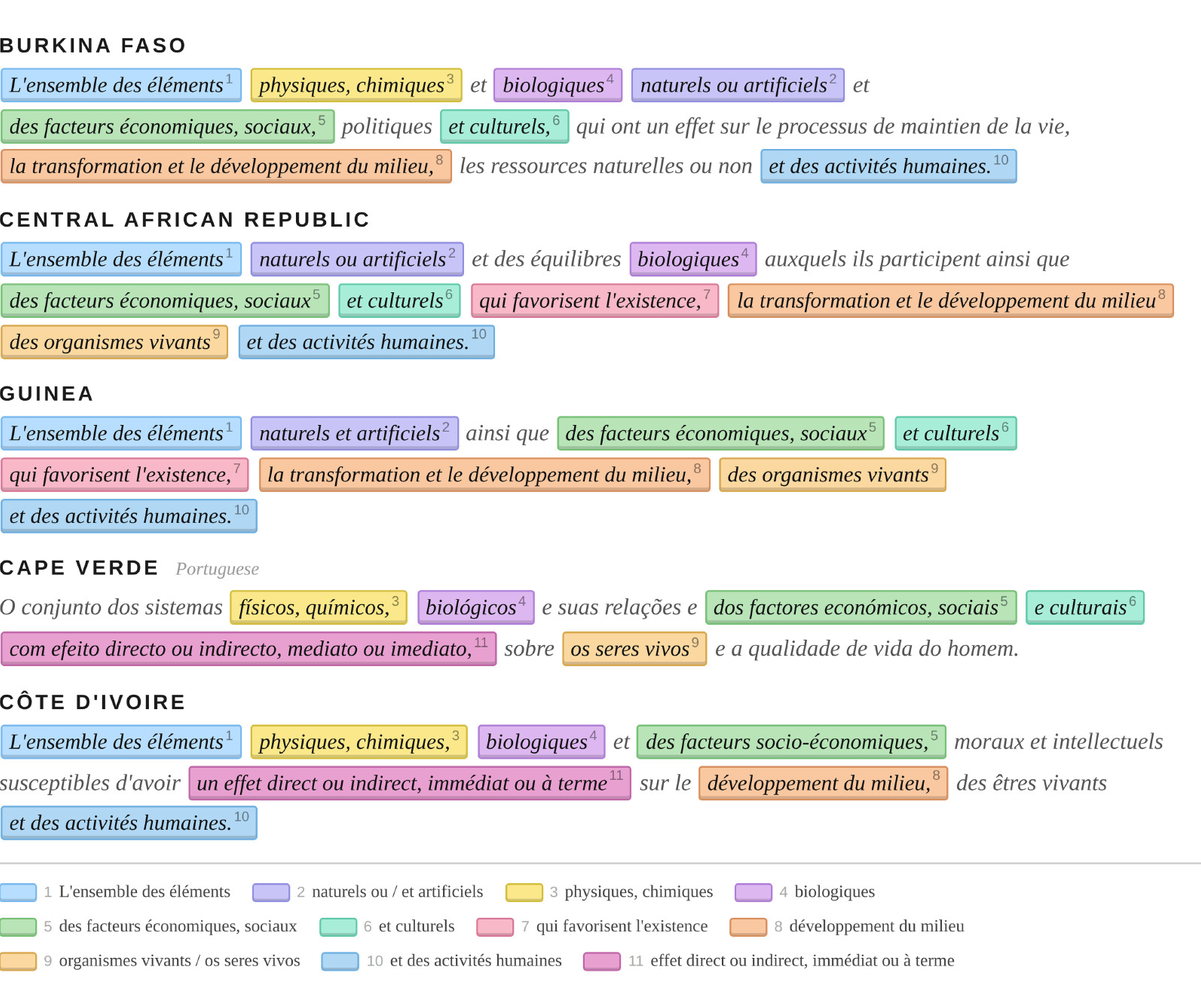
Figure 4: The modular structure of environmental definitions. Source: author.
Figure 4 suggests a refinement of bricolage as an explanatory concept. Existing accounts often describe legal systems as assemblages of borrowed institutional forms, but the level at which this assembly occurs remains underspecified. Here, the process becomes visible at the level of language itself, offering a rare view of the micro-mechanics of legal bricolage. What appears to circulate are not complete statutes or fully formed regulatory models, but clusters of recurring phrases and provisions that can be incorporated into different legislative settings. The highlighted definitions reveal a common vocabulary from which lawmakers appear to draw, making visible the textual building blocks from which environmental law is assembled. Very few countries adopt identical definitions. Rather than simple cutting and pasting, lawmakers selectively edit, rework and recombine recurring textual elements. The same textual building blocks recur in different combinations, producing definitions that appear unique overall even when none of their component parts are original.
In other cases, while most of the definition followed a familiar script, new concepts were introduced. These additions reflect the originality that emerged as legislators tweaked and extended the template to incorporate local concerns or address perceived gaps. These examples speak to the agency of national legislative drafting processes, countering the disempowering and deterministic narratives of wholesale imposition of foreign models. The examples below illustrate how otherwise familiar definitions were modified through the insertion of locally specific elements:
‘… ainsi que le maintien des paysages et des espèces naturels.’ (Djibouti)[77]
‘… facteurs économiques, sociaux, politiques et culturels …’ (Burkina Faso)[78]
‘… facteurs socio-économiques, culturels, esthétiques, scientifiques …’ (Rwanda)[79]
‘… physical, ecological, archaeological, aesthetic, cultural, economic, institutional, human health and social aspects’ (Botswana)[80]
‘… facteurs socio-économiques, moraux et intellectuels …’ (Côte d’Ivoire)[81]
Seen in this light, definitions of the ‘environment’ offer a small but revealing window into the mechanics of legal assembly. Legislators did not replicate a single authoritative formulation. Instead, they assembled definitions from a shared repertoire of textual fragments. What travelled was not a single authoritative definition of the environment, but the textual building blocks from which different versions of that definition could be assembled.
For some, these findings might resonate with work on mobility in science and knowledge studies, including Bruno Latour’s concept of ‘immutable mobiles’[82] and Mary Morgan’s account of ‘travelling facts’.[83] Both scholars emphasise how ideas, knowledge and representations acquire influence through their capacity to move across contexts while retaining sufficient stability to remain recognisable and usable. What persists across jurisdictions is not an entire legal form. Rather, stability appears to reside in recurring textual and conceptual elements that retain a certain ‘steadiness, and even sturdiness’, to adopt Morgan’s language, even as the surrounding legal framework is reworked.[84] Templates dissolve a binary that has long structured diffusion scholarship: copied or original. Legal texts can be both at once.
D. More than text on the move: an impact assessment ‘mindset’
The textual patterns identified thus far suggest that legislative language was on the move. Yet what travels with EIA is more than legislative text. An important insight from this project is that EIA has spread not only geographically but also conceptually. As a legal technology, EIA has spawned multiple generations of impact assessment (IA), including social IA, cumulative IA, strategic IA, gender IA, human rights IA, climate IA, health IA and sustainability IA.
The influence of EIA now extends well beyond environmental law. Its practices have shaped fields ranging from human rights due diligence to health IA, while the broader habit of recasting diverse social and environmental concerns as impacts to be managed has become deeply embedded in contemporary regulation. This framing has extended into climate governance. Contemporary climate risk assessments increasingly present climate change through the lens of socioeconomic risks: quantifiable, manageable, amenable to mitigation. Seen this way, climate harm becomes something to be mitigated rather than a systemic disruption requiring transformation.[85]
Interestingly, it was not EIA’s success that led to the proliferation of other forms of IA. Rather, many of these practices emerged in response to EIA’s perceived gaps and limitations. EIA’s failure to robustly account for the social consequences of development projects helped spur the development of social IA. The project-specific focus of EIA, in turn, prompted efforts to develop cumulative IA. Over time, a broader ecosystem of assessment practices has emerged. The IAIA has played an important role in encouraging this expansion, developing templates, best practices, training materials, and guidance across multiple forms of assessment and acting as a force for standardisation.
These developments invite reflection on the mindset embedded in IA itself. Viewing the natural world through the lens of ‘impacts’ frames environmental harm primarily as something that can be mitigated or reduced, rather than avoided altogether. It entrenches a vision of the environment as a resource to be exploited for human purposes. This helps explain why highly disruptive development projects continue to be proposed with the assurance that they will be ‘subject to EIA’.[86] What emerges is a seductive vision of EIA: a mechanism that reassures publics and project opponents while allowing development to proceed. This stands in tension with the enduring celebration of EIA as one of the most innovative environmental policy developments of the last century.
4. Environmental law and the allure of templates
A. Why templates? The quest for speed and scale
Templates are not a peculiarity of EIA. They are central to how law works. Templates offer ease, efficiency, accessibility, familiarity and a low-cost starting point for drafting legal instruments.[87] The legal process, grounded in traditions as foundational as the common law, is permeated by both explicit and implicit reliance on precedent and prior examples.
Working from familiar or pre-existing language is a recognisable element of legal craft. Lawyers frequently begin with earlier documents, adapting and refining established wording to suit new circumstances. Time and cost are persistent constraints in legal practice, and reliance on boilerplate often reflects these institutional realities. In regulatory settings, for example, the use of standardised language in Environmental Impact Statements has been described as a ‘coping strategy’ adopted by overburdened administrative agencies responding to institutional pressures.[88]
Lawyering thus often involves tailoring rather than creating wholly bespoke legal forms. Designing entirely new architectures for a single transaction is expensive and time-consuming, and these realities shape who can access highly customised legal services. By contrast, the free and public circulation of model texts and drafting templates carries important access-to-justice implications. It is therefore unsurprising that environmental non-profit organisations and academic institutes increasingly produce and share model law templates as tools to support sustainability-oriented and climate-sensitive legal drafting.[89] Templates are tools designed to meet the twin demands of speed and scale.
The growing use of artificial intelligence is likely to reinforce reliance on templates rather than diminish it.[90] Large language models are trained on vast corpora of existing texts and operate by identifying patterns and recombining previously observed language. In practice, this means that AI-assisted drafting tends to reproduce and refine existing textual structures rather than generate wholly novel ones. As a result, AI tools and tech-based prototypes often amplify the circulation of familiar formulations, clauses and drafting conventions across jurisdictions.[91] Yet the sources and inspirations behind these AI-generated templates remain largely invisible. The textual patterns embedded in training data shape the language that emerges, but the origins of those patterns are rarely identifiable.
This anonymity mirrors a long-standing feature of template-based lawmaking: questions of voice are central to the uptake of templates. To maximise their portability, model texts are often deliberately stripped of contextual markers that would tie them to a particular jurisdiction, institution or author. This intentional decontextualisation facilitates replication across diverse settings. Legal drafting, whether of legislation, administrative guidance or contractual clauses, therefore pursues goals that differ from those of academic writing.[92] Rather than foregrounding analytical argument or interpretive debate, it aims to produce language that can be readily implemented and adapted in practice.
Yet portability alone does not explain why some templates travel while others do not. Their circulation also depends on the organisations and sources of authority that promote particular legal approaches and make them available for adoption. Voice matters as much as text. Carolyn Abbot and Maria Lee have shown how the ‘self-belief and immense sense of agency’ of certain organisations enables them to extend their legal vision across jurisdictions.[93] Template diffusion is not simply a matter of moving texts. It also reflects the confidence to propose that what worked in one place might work elsewhere, even everywhere.
B. Building better templates
The concept of template legal culture opens important avenues for both future research and research-informed legal practice. Rather than cataloguing the many risks and blind spots associated with templates,[94] this section asks whether template legal culture might be deliberately harnessed to improve environmental governance. That question cannot be separated from the history through which many legal templates have travelled. In the context of EIA, this begins with acknowledging that the global spread of environmental assessment legislation was not and is not simply a neutral transfer of a useful regulatory technique.
A word on language. The concerns animating this section, which include contextualisation, the erasure of local knowledge, and the projection of particular legal visions across jurisdictions, are sometimes gathered under the term ‘decolonial’. That term is not used here. As Tuck and Yang have influentially argued, the ease with which the language of decolonisation has been adopted across the social sciences risks supplanting prior and more precise vocabularies for talking about social justice, and obscures the fact that decolonisation ‘wants something different’ from other forms of justice.[95] Applying it as a metaphor for concerns about legal contextualisation and epistemic erasure risks doing precisely what this article cautions against: borrowing a framework without attending to what is lost – or misappropriated – in transit.
Templates that arrive stripped of context do not merely simplify: they foreclose. Model laws and legislative blueprints often carry implicit assumptions about governance, expertise and institutional capacity that may not align with local legal cultures or political priorities. The structure of legislation, the terminology deployed and the procedural logic embedded in many EIA frameworks frequently reflect Anglo-American administrative law traditions. Seen in this light, template legal culture risks becoming another mechanism through which particular legal visions are projected across jurisdictions without sufficient attention to context, voice or power.
The risks are real. Whether templates can be designed to serve locally grounded legal ambitions remains an open question. Arpitha Kodiveri offers a cautionary example in her study of climate litigation in Bangladesh.[96] Kodiveri documents how the strategic pursuit of a ‘winning’ climate case can prioritise the creation of transportable legal templates over the needs and priorities of local communities. In this account, the process of case-building itself becomes a site of tension between imported legal strategies and localised forms of legal reasoning, displacing local concerns in favour of a portable litigation model. The paths towards climate justice that Kodiveri identifies instead explicitly emphasise resistance to externally imposed templates, drawing on local legal traditions, climate justice movements and the capacities of national courts.
Comparison also requires careful reconsideration, particularly given its central role in EIA policy and practice. Comparative approaches have long reinforced narratives of the implied superiority of governance models associated with the Global North.[97] Treating these models as the default reference point produces what has been described as an ‘odd duck syndrome’, casting Global South legal experiences as exceptional when they are not.[98] Similar dynamics appear in the construction of other ostensibly universal concepts, such as sustainable development, which have often muted alternative voices, knowledges and ways of knowing.[99] Yet alternative modes of comparison, and of learning across legal systems, are emerging. One example is the growing circulation of Indigenous-led environmental assessment models across jurisdictions. Indigenous-led assessment has developed in response to the limitations of conventional EIA processes, particularly their reductionist tendency to assess impacts on Indigenous rights and title primarily through biophysical measurements.[100]
Case studies of these assessment processes are being shared in a way that departs from a template or model mindset, instead promoting knowledge transfer through sharing experience and a multiplicity of potential models. As the authors of one collection of case studies explain:
Although our work focuses on Canada, the examples and tools can be valuable for Indigenous peoples and EIA practitioners in jurisdictions elsewhere who are looking to understand how ILIA [Indigenous-led impact assessment] might be operationalized to reflect their settings, values, and priorities. The results are helpful to Indigenous governments and groups looking to develop their own approaches to assessment, and for understanding the relative strengths and experiences of options they may consider or adapt for their own needs.[101]
The mindset and approach through which models ‘from elsewhere’ are shared illuminates the point that templates are not just tools. They are embodiments of knowledge practices. Focusing solely on legislative text obscures this reality.
C. Templates as both tools and knowledge practices
This section shifts perspective, moving from treating templates as tools to recognising them as knowledge practices. That shift opens new ways of approaching template use with explicit attention to the risks they carry. As Geoffrey West has shown, systems that scale successfully rely on modular structures that allow components to be replicated and recombined as systems expand.[102] Similarly, César Hidalgo emphasises that complex forms of knowledge grow through networks that distribute and recombine pieces of information across institutions and communities. To illustrate how complex knowledge can be embedded within seemingly simple products, Hidalgo points to the example of a tube of toothpaste:
[W]hen we are buying toothpaste we are not simply buying paste in a tube. Instead, we are buying access to the practical uses of the creativity of the person who invented toothpaste, the scientific knowledge informing the chemical synthesis that is required to make toothpaste, the knowhow required to synthesize sodium fluoride, put it inside a tube, and make it available across the planet, and the knowledge that fluoride makes our teeth stronger and has beneficial effects on our health.[103]
Templates perform a comparable function in law. They provide modular units of legal language that can be assembled, modified and circulated across jurisdictions, allowing legal frameworks, structures and vocabularies to travel rapidly. Yet the portability that enables such scaling can obscure the knowledge embedded within them. When legal language travels more easily than the institutional knowledge required to sustain it, gaps can emerge between formal legislative adoption and the knowledge practices necessary to give that legislation meaning.
Put differently, legal text can proliferate quickly and cheaply, while institutional knowledge develops and circulates more slowly. This asymmetry creates risks of knowledge loss and knowledge erasure.[104] Addressing those risks requires deliberate efforts to make critical knowledge visible and to ensure that what travels is not a stripped-down template devoid of questions, cautions and contextual insights. At times, the abstraction of templates, and the pared-down structure of knowledge characteristic of checklist-style approaches, can serve practical purposes.[105] Given the persistence of template use in practice, this invites reflection on how templates might be designed and employed in ways that are attentive to the insights of critique and to the knowledge practices they embed.[106]
One response is to build reflexivity directly into legal templates. Rather than treating templates as neutral vehicles for transmitting legal rules, they could be designed to prompt critical engagement with the assumptions they carry.[107] A critically reflexive review template might, for example, incorporate questions that invite policymakers to consider whether proposed legislation reproduces inherited legal structures or instead supports locally grounded environmental governance, Indigenous authority and plural knowledge systems. Used alongside existing knowledge practices rather than as a stand-alone tool, such a template could help consolidate and amplify approaches that already exist within EIA practice but often circulate in fragmented and ad hoc ways. Reflexivity, adaptation and refusal could become part of the template itself.
5. Concluding thoughts
This inquiry began with questions that are familiar within accounts of legal diffusion. Which model laws influenced EIA’s rapid global development? Through what pathways did EIA spread across jurisdictions? What forms of power, influence and authority shaped that expansion? Yet the search for answers ultimately revealed the limits of these questions as an explanatory framework. Rather than uncovering a chain of legal inheritance anchored in identifiable model laws, the analysis revealed a transnational repertoire of provisions, textual fragments and drafting practices that circulated across jurisdictions and were repeatedly recombined in new legislative forms. Taking a second look at this body of law, this time through its templates, reveals dimensions of legal change that are difficult to see through questions of origin and influence alone.
This shift in perspective has implications for how environmental law’s history is understood. That EIA became a cornerstone of environmental governance in so many jurisdictions was not inevitable. Alternative approaches to environmental protection, alternative focal points for legal and policy attention, and alternative legal vocabularies might have emerged instead.[108] Through its global spread, EIA helped institutionalise particular ways of conceptualising the environment and of understanding environmental degradation through the language of impacts. This framing renders environmental harm legible to legal and administrative systems. It can also narrow attention to discrete effects and mitigation measures at the expense of broader ecological transformations.
These conversations are not unique to environmental law. The global spread of EIA reveals the diffusion of ‘forms of legal consciousness and accompanying standards of professional practice’ that have travelled with other episodes of legal globalisation, including the spread of US legal ideas and the institutional frameworks that facilitate market transactions.[109] Environmental law thus joins ‘property and sovereignty’ as sites through which ‘particular ideas about civilization, development and good governance’ have been encoded through legal vocabularies.[110] Templates are one of the mechanisms through which those ideas travel and endure.
Templates are more than technical devices. They help determine how problems are framed, what forms of governance appear possible, and which legal solutions become embedded as defaults. Their invisibility makes them difficult to scrutinise, while their pervasiveness makes them equally difficult to dislodge. Laws may be rewritten and new critiques developed, yet both often emerge through familiar legal forms. The obstacle to transformation is not simply that old ideas survive. It is that the templates through which law is made can quietly set the terms on which alternatives become thinkable.
-
Natasha Affolder, ‘Contagious Environmental Lawmaking’ (2019) 31 Journal of Environmental Law 187. ↑
-
Defined as a ‘systematic and formalized legal process that obligates a decision about whether a project or activity should proceed – and on what basis – after considering, first, information about the potential environmental impacts of a project, and second, wider public consultation in light of that information’. Elizabeth Fisher, ‘Environmental Impact Assessment: “Setting the Law Ablaze”’ in Douglas Fisher (ed), Research Handbook on Fundamental Concepts of Environmental Law (Edward Elgar Publishing 2016) 423. ↑
-
Tseming Yang and Robert V Percival, ‘The Emergence of Global Environmental Law’ (2009) 36 Ecology Law Quarterly 615, 627. ↑
-
Barry Sadler, Environmental Assessment in a Changing World: Evaluating Practice to Improve Performance (Canadian Environmental Assessment Agency 1996) i. ↑
-
Nicolas de Sadeleer, Environmental Principles: From Political Slogans to Legal Rules (OUP 2002) 87. ↑
-
Discourses of travel need to be grounded in the fact that EIA can be conceived very differently in different contexts, reflecting diverse understandings of state authority, of the division of rights and obligations, of the purpose of EIA, of what counts as public participation, and of whom those relevant ‘publics’ might be. ↑
-
As Neil Craik has observed, ‘[EIA] has been both lauded as a significant legal innovation and criticized as inefficient and ineffective since its creation in 1970’. Neil Craik, ‘The Assessment of Environmental Impact’ in Neil Craik, Emma Lees and Jorge E Viñuales (eds), The Oxford Handbook of Comparative Environmental Law (OUP 2019) 876, 877. ↑
-
As a concept, EIA can be thought of as ‘a culturally significant evocation’ of the importance of embedding environmental concerns in decision-making, reflecting the ‘absorption’ of ecological thinking into environmental law doctrine. Jane Holder, Environmental Assessment: The Regulation of Decision-Making (OUP 2006) 60. ↑
-
The global diffusion of EIA thus offers evidence for a proposition that may receive insufficient attention in accounts of international norm-setting: that procedural forms, not only substantive commitments, are the objects of transnational spread. What travels is not only an idea but a process. ↑
-
National Environmental Policy Act 1969, Pub L 91-190, 83 Stat 852, codified at 42 USC §§ 4321–4370h. ↑
-
For consistency, this study focused on the first statutory enactment of an EIA requirement in a jurisdiction, rather than the first administrative policy or guidance on EIA. This is an important distinction. Many countries introduced EIA policies and practices before enacting national-level legislation, often in the form of an environmental code or charter. ↑
-
Tseming Yang, for example, attributes his detailed knowledge of EIA spread to his own ‘personal experiences’, remarking that ‘formal documentation of how widespread EIA transplantation efforts have become difficult to assess, especially since training materials are not usually published’. Tseming Yang, ‘The Emergence of the Environmental Impact Assessment Duty as a Global Legal Norm and General Principle of Law’ (2019) 70 Hastings Law Journal 48. ↑
-
Craik (n 7) 877. ↑
-
On the value and limitations of conventional methods and frameworks for tracing the spread of legal ideas, see Affolder (n 1) 196–99. ↑
-
Even something as seemingly uncontroversial as the date of adoption of a country’s first statute mandating EIA can be debated. For consistency, in constructing these graphics, we documented the first statutory enactment rather than a country’s first guideline or policy on EIA. In the case of Canada, for example, that meant documenting the first federal act, the Canadian Environmental Assessment Act (1992), rather than the first policy, the Environmental Assessment and Review Process Guidelines Order (1973). ↑
-
For a more detailed reflection on the narratives that have shaped accounts of EIA’s global spread, and their limitations, see Affolder (n 1). ↑
-
The terminology of ‘developing’ and ‘developed’ countries, and ‘Global North’ and ‘Global South’, carries problematic roots in racism and colonialism. These terms are used here with that reality acknowledged. See Themrise Khan and others, ‘How We Classify Countries and People – and Why It Matters’ (2022) 7 BMJ Global Health e009704. ↑
-
Underlying the promotion of universal standards is a largely unspoken assumption: that the environmental problems EIA is designed to address are everywhere essentially the same. The portability of best practice frameworks depends on, and reinforces, that premise. ↑
-
The settlement to a successful public interest case against the United States Agency for International Development in 1975 extended NEPA’s mandate by compelling federal agencies to evaluate the extraterritorial ecological impacts of overseas development assistance. Environmental Defense Fund v Agency for International Development, 6 ELR 20,121 (US District Court for the District of Columbia 1975). ↑
-
‘Indeed, except for the other EC member states, each legislature that has followed the lead of Congress in enacting EIA has done so unilaterally. No duty imposed under a framework treaty or the exhortation of a United Nations resolution has produced this result. Rather, the world has embraced EIA on its own merits.’ Nicholas A Robinson, ‘International Trends in Environmental Impact Assessment’ (1991) 19 Boston College Environmental Affairs Law Review 591, 591. ↑
-
Norman Lee, ‘Environmental Assessment: Nature, Scope and Historical Development’ in Ed Bellinger and others (eds), Environmental Assessment in Countries in Transition (Central European University Press 2000) 5, 7. ↑
-
The tendency to present legal flows from the Global North as meeting passive or receptive audiences in the Global South has been persuasively critiqued. As Obregón argues, peripheral histories reveal forms of agency, resistance and alternative legal imagination that dominant diffusion narratives systematically obscure. Liliana Obregón, ‘Peripheral Histories of International Law’ (2019) 15 Annual Review of Law and Social Science 437. ↑
-
None of these three terms is up to the task of capturing the importance of ‘background’ law and legal culture. ↑
-
Diane M Kohn, ‘Setting a Standard: Environmental Impact Assessment Policies of Multilateral Development Banks and Export Credit Agencies’ (2002) 9 Environmental Law 281, 281. ↑
-
Wenming Chen, Kimberly A Warren and Ning Duan, ‘Incorporating Cleaner Production Analysis into Environmental Impact Assessment in China’ (1999) 19 Environmental Impact Assessment Review 457, 466; Oleg Cherp, ‘EA Legislation and Practice in Central and Eastern Europe and the Former USSR: A Comparative Analysis’ (2001) 21(4) Environmental Impact Assessment Review 335, 350. ↑
-
The domestic legislation of other countries, particularly donor countries, and multilateral development bank approaches were sources of these influential models: ‘Egypt and Lebanon’s screening categories are largely based on the three categories developed by the World Bank … The former developed its EIA legislation with the collaboration of the Danish group Danish International Development Agency (DANIDA), while the latter was largely influenced by international donors: it developed its EIA policies through a World Bank fund’. Karma El-Fadl and Mutasem El-Fadel, ‘Comparative Assessment of EIA Systems in MENA Countries: Challenges and Prospects’ (2004) 24 Environmental Impact Assessment Review 553, 563. ↑
-
Arend J Kolhoff, Peter PJ Driessen and Hens AC Runhaar, ‘An Analysis Framework for Characterizing and Explaining Development of EIA Legislation in Developing Countries-Illustrated for Georgia, Ghana and Yemen’ (2013) 38 Environmental Impact Assessment Review 1. ↑
-
International Association for Impact Assessment, Best Practice Principles of Environmental Impact Assessment (IAIA 1999). ↑
-
Kolhoff, Driessen and Runhaar (n 27) 1. ↑
-
ibid. The Principles notably drew upon the influential 1996 study of EIA effectiveness. Sadler (n 4). ↑
-
See Richard K Morgan, ‘Conceptualising Best Practice in Impact Assessment’ (2017) 66 Environmental Impact Assessment Review 78. ↑
-
‘In 2005 the World Bank reviewed the EIA legislation [passed in Ghana] and concluded that Ghana had established an ambitious EIA legislation that was almost in compliance with World Bank standards for EIA … The World Bank EIA standards are comparable with the EIA best practice model described by IAIA (1999).’ Kolhoff, Driessen and Runhaar (n 27) 11. ↑
-
ibid 2. One version of this tension is evident in the EU. The EU’s EIA Directive has been a disciplining force on Member States that have tailored EIA to their own planning systems with the European Court of Justice exerting its influence to bring implemented versions back in line with the original template of the Directive. ↑
-
See eg UNEP, ‘Environmental Impact Assessment and Strategic Environmental Assessment: Towards an Integrated Approach’ (UNEP 2004) 16. (‘Each country will have particular needs and realities that must be taken into account in EIA development and capacity building. These requirements are being given increasing attention, although the documentation may not be readily available or accessible’). This 2004 report acknowledged that ‘[i]n certain countries, EIA legislation based on an imported framework can be inappropriate and dysfunctional. This is a matter of concern in Africa’ (at 19). ↑
-
Affolder (n 1) 196. ↑
-
Sadler (n 4). ↑
-
‘Implementation failure’ has become a catch-all phrase that denotes distinct concerns ranging from lack of enforcement to the lack of fit of foreign-inspired models. In other contexts, scholars have valuably pushed back against the conclusion that the failure to ‘implement’ international standards and best practices adequately explains environmental conflict. See Ben Boer and others (eds), The Mekong: A Socio-Legal Approach to River Basin Development (Routledge 2016) 192 (‘we did ultimately concur that conflict surrounding hydropower development in the Mekong River Basin could not simply be disciplined out of existence by the fuller or more willing implementation of blueprints drawn from international law or global ‘best practice’). ↑
-
Hironaka advances a hypothesis that international organisations have been prime movers in the proliferation of EIA between jurisdictions. She draws on the policy promotion of EIA within UNEP and the OECD as well as the IUCN, discussing their advocacy both as prioritising environmental concerns within national agendas and as establishing an international norm which countries have been pressured to attain. See Ann Hironaka, ‘The Globalization of Environmental Protection: The Case of Environmental Impact Assessment’ (2002) 43 International Journal of Comparative Sociology 65. ↑
-
See Ann Hironaka and Evan Schofer, ‘Decoupling in the Environmental Arena: The Case of Environmental Impact Assessments’ in Marc J Ventresca and Andrew J Hoffman (eds), Organizations, Policy, and the Natural Environment (Stanford University Press 2002) 214, 222. ↑
-
Brent Doberstein, ‘Environmental Capacity-Building in a Transitional Economy: The Emergence of EIA Capacity in Viet Nam’ (2003) 21 Impact Assessment and Project Appraisal 25, 25. ↑
-
Hironaka (n 38). ↑
-
Hironaka and Schofer’s work did not identify the sources of these models. And their theoretical account is not the only explanation of EIA’s spread. Holm-Hansen, for example, accounts for the mismatch between legislation and implementation as residing in the fact that EIA was ‘conceived in and for a developed Western situation’. Jørn Holm-Hansen, ‘Environmental Impact Assessment in Estonia and Norway’ (1997) 17 Environmental Impact Assessment Review 449, 449. ↑
-
For a convincing case of why legislation is worth studying, see Eloise Scotford, ‘Legislation and the Stress of Environmental Problems’ (2021) 74 Current Legal Problems 299. ↑
-
Harold Fowler and Ana Maria Dias De Aguiar, ‘Environmental Impact Assessment in Brazil’ (1993) 13 Environmental Impact Assessment Review 169, 170. ↑
-
M El-Fadel, M Zeinati and D Jamali, ‘Framework for Environmental Impact Assessment in Lebanon’ (2000) 20 Environmental Impact Assessment Review 579, 563. ↑
-
See Richard A Carpenter, ‘Balancing Economic and Environmental Objectives: The Question Is Still, How?’ (1981) 2 Environmental Impact Assessment Review 175, 177; John O Kakonge and Anthony M Imevbore, ‘Constraints on Implementing Environmental Impact Assessments in Africa’ (1993) 13 Environmental Impact Assessment Review 299, 304. ↑
-
Jane Turnbull, ‘Environmental Impact Assessment in the Fijian State Sector’ (2003) 23 Environmental Impact Assessment Review 73, 82–83. ↑
-
Carpenter (n 46) 180. ↑
-
ibid 181–82. ↑
-
ibid 182. ↑
-
Kolhoff, Driessen and Runhaar (n 27) 5. ↑
-
For a rare, interview-based study of the drafting processes leading to EIA legislation in Georgia, Ghana and Yemen, see Kolhoff, Driessen and Runhaar (n 27). ↑
-
AL Brown, RA Hindmarsh and GT McDonald, ‘Environmental Assessment Procedures and Issues in the Pacific Basin-Southeast Asia Region’ (1991) 11 Environmental Impact Assessment Review 143, 144. ↑
-
Lenka Zvijáková, Martina Zeleňáková and Pavol Purcz, ‘Evaluation of Environmental Impact Assessment Effectiveness in Slovakia’ (2014) 32 Impact Assessment and Project Appraisal 150, 157. ↑
-
On the compromises involved in global knowledge projects, see Perrin Selcer, The Postwar Origins of the Global Environment: How the United Nations Built Spaceship Earth (Columbia University Press 2018). ↑
-
Linda Colley, The Gun, the Ship, and the Pen: Warfare, Constitutions, and the Making of the Modern World (Liveright Publishing 2021) 11 (‘It follows that paying close attention to the provisions and the wording of different constitutions drafted across time and in multiple places is vital, because it is only by doing so that we can uncover, identify, and unpick the many and various visions and ideas that were involved’). ↑
-
And yet cautionary tales of the missteps that have accompanied the use of computational and statistical methods in comparative law, and the desire to build grand theories from such data analysis, abound. See in particular Simon Deakin and Katharina Pistor (eds), Legal Origin Theory (Edward Elgar Publishing 2012). ↑
-
Methodological struggles are important to share, and mine will be the subject of a separate article. ↑
-
On the significance of scalar and jurisdictional choices in legal analysis, and the way in which the ‘chunks’ of legal territory we choose to investigate shape what becomes visible, see Mariana Valverde, ‘Jurisdiction and Scale: Legal Technicalities as Resources for Theory’ (2009) 18 Social & Legal Studies 139. ↑
-
For a discussion of how the ‘global turn’ in history ends up reinforcing the very asymmetries that it seeks to address, see Gabriela De Lima Grecco and Sven Schuster, ‘Decolonizing Global History? A Latin American Perspective’ (2020) 31 Journal of World History 425, 431. ↑
-
This choice also reflected the language capabilities of our research team and the need to begin with a manageable data set as we refined our methods. ↑
-
The legislation introducing an EIA requirement was generally the first environmental code to be enacted by that state. In the case of the Francophone African corpus of legislation, this included Environmental Codes enacted between 1983 (Algeria) and 2011 (Democratic Republic of the Congo). ↑
-
All numerical similarity analysis and the figures were generated and developed by Daniel Draper using software available at https://github.com/danpdraper/eia. ↑
-
This history and the dominant role of international lenders within it are more fully explored in Diane Henkels, ‘A Close up of Malagasy Environmental Law’ (2001-2002) 3 Vermont Journal of Environmental Law 47. ↑
-
Géraldine Froger and others, ‘Towards an Institutional and Historical Analysis of Environmental Policy in Madagascar’ (2012) 22(5) Environmental Policy and Governance 319. ↑
-
For example, Guinea and Algeria emerged as probable sources of influence over prototypical provisions in the Francophone corpus. The network diagrams that highlighted this phenomenon did not, however, reveal single origins, dominant models or straightforward pathways of diffusion. They are therefore not reproduced here. The density of nodes and edges within a geographically concentrated corpus made visual interpretation unreliable, and directed edges, assigned to the jurisdiction whose legislation was enacted earliest within each provision group, could indicate probable influence but not confirm it. At most, the diagrams suggested that particular statutes were more likely sources of influence than their peers. ↑
-
This observation fits Ogunba’s description of Nigeria’s experience with EIA, drawing on ‘a mismatch of procedures’ modelled on distinct American and British examples. Olusegun A Ogunba, ‘EIA Systems in Nigeria: Evolution, Current Practice and Shortcomings’ (2004) 24 Environmental Impact Assessment Review 643, 648–49. ↑
-
Government of India, Environmental Impact Assessment Notification 1994 (Ministry of Environment and Forests, SO 60(E), 27 January 1994). ↑
-
For a vivid portrayal of bricolage at work in the ‘invisible practices’ that underlie international dispute settlement, see Tommaso Soave, The Everyday Makers of International Law: From Great Halls to Back Rooms (CUP 2022) ch 10. ↑
-
Claude Lévi-Strauss, The Savage Mind (University of Chicago Press 1966) 11–13; Frances Cleaver, Development Through Bricolage: Rethinking Institutions for Natural Resource Management (Earthscan 2012). ↑
-
On bricolage as a mode of incremental institutional change, see Kathleen Thelen, How Institutions Evolve (CUP 2004). For its application in socio-legal scholarship, see Boaventura de Sousa Santos, Toward a New Legal Common Sense (2nd edn, Butterworths 2002); Mariana Valverde, Chronotopes of Law: Jurisdiction, Scale and Governance (Routledge 2015). ↑
-
Annelise Riles, The Network Inside Out (University of Michigan Press 2000). See also Annelise Riles, ‘A New Agenda for the Cultural Study of Law: Taking on the Technicalities’ (2005) 53 Buffalo Law Review 973, which develops the argument that legal technique and form deserve analytical attention in their own right rather than being treated as mere scaffolding for substantive norms. ↑
-
Katharina Pistor, The Code of Capital: How the Law Creates Wealth and Inequality (Princeton University Press 2019). ↑
-
Environmental Protection Act 1970 (Vic, Australia), Art. 4(1). ↑
-
Florian Charvolin, ‘1970: L’année clef pour la définition de l’environnement en France’ [2001] La revue pour l’histoire du CNRS. ↑
-
For a book-length investigation of the terms environment and environmentalism, see Etienne S Benson, Surroundings: A History of Environments and Environmentalisms (University of Chicago Press 2020). ↑
-
Loi portant sur le cadre de l’environnement, Loi No 106/AN/00/4ème L (Djibouti, 2000). ↑
-
Loi portant Code de l’environnement, Loi No 005/97/ADP (Burkina Faso, 1997). ↑
-
Loi organique portant modalités de protection, de conservation et de promotion de l’environnement au Rwanda, Loi organique No 04/2005 du 08/04/2005 (Rwanda). ↑
-
Environmental Impact Assessment Act 2005 (Botswana). ↑
-
Loi portant Code de l’environnement, Loi No 96-766 (Côte d’Ivoire, 1996). ↑
-
Bruno Latour, Science in Action: How to Follow Scientists and Engineers Through Society (Harvard University Press 1987) 215–232. ↑
-
Mary S Morgan, ‘Travelling Facts’ in Peter Howlett and Mary S Morgan (eds), How Well Do Facts Travel? The Dissemination of Reliable Knowledge (CUP 2011) 3, 5–8. ↑
-
ibid 11. ↑
-
McKinsey Global Institute, Climate Risk and Response: Physical Hazards and Socioeconomic Impacts (2020) 164. ↑
-
Witness current discussions that deep sea bed mining can advance in international waters as long as it is subject to EIA. ↑
-
In the context of legislative drafting, ‘the constant pressure exerted by bill sponsors for the preparation of “quick bills”, inadequate policy instructions and the perceived ability of legislative precedents and templates to offer “quick solutions” have contributed to the use of precedents by drafters … [and explain why] drafters rely on precedents, templates and model laws from other jurisdictions.’ Agnes Quartey Papafio, ‘Drafting Conventions, Templates and Legislative Precedents, and Their Effects on the Drafting Process and the Drafter’ (2013) 15 European Journal of Law Reform 371, 373. ↑
-
Tyler A Scott, Nicholas Marantz and Nicola Ulibarri, ‘Use of Boilerplate Language in Regulatory Documents: Evidence from Environmental Impact Statements’ (2022) 32 Journal of Public Administration Research and Theory 576. ↑
-
See eg ‘Model Climate Laws Initiative’ (Model Climate Laws Initiative) <https://modelclimatelaws.org/> accessed 12 April 2026; Jennifer Ramos, ‘Shifting the Mindset of Commercial Lawyers to Rewire Contracts, to Mitigate Climate Change More Effectively in Practice: The Chancery Lane Project’ (2021) 23 Environmental Law Review 3. ↑
-
On the conversations happening and not happening in environmental law around digital technologies, see Cameron Holley and others, ‘Siloes and Silences: A Review and Reflection on Environmental Law and Digital Technology Scholarship’ [2025] Law, Innovation and Technology 1. ↑
-
Andrea Leiter and Marie Petersmann, ‘Tech-Based Prototypes in Climate Governance: On Scalability, Replicability, and Representation’ (2022) 33 Law and Critique 319. ↑
-
Annelise Riles, ‘Models and Documents: Artefacts of International Legal Knowledge’ (1999) 48 International and Comparative Law Quarterly 805, 817. ↑
-
Carolyn Abbot and Maria Lee, ‘Philanthropy Shaping Environmental Law: The “Influence of Thought”’ [2026] Journal of Environmental Law eqag002, 1. For further elaboration of the argument that people and money both matter in explaining the spread of legal forms, see Natasha Affolder, ‘Transnational Environmental Law’s Missing People’ (2019) 8 Transnational Environmental Law 463, 485–86. ↑
-
Many of these blind spots correspond with the ‘traps’ that circulate in and through global narratives about EIA’s global spread: disguised policy agendas, ahistorical accounts, false universalism, misappropriation of Indigeneity, and the anonymity of actors and funding sources. They are more fully explored in Affolder (n 1). They underline the inherent challenges of viewing the global movement of legislation as the product of ‘flows, networks, and governance assemblages’ rather than as the work of individual people. See Valverde (n 71) 106. ↑
-
Eve Tuck and K Wayne Yang, ‘Decolonization is Not a Metaphor’ (2012) 1(1) Decolonization: Indigeneity, Education & Society 1, 2. ↑
-
Arpitha Kodiveri, ‘Climate Litigation as Template Making: Adjudication and Homogenization of Legal Strategies on Loss and Damage’ in Melanie Murcott and Myriam Giquello (eds), Adjudicating Climate Change: Extra Legal Factors (Bloomsbury, forthcoming). ↑
-
Daniel Bonilla Maldonado, Legal Barbarians: Identity, Modern Comparative Law and the Global South (CUP 2021) 9; Lena Salaymeh and Ralf Michaels, ‘Decolonial Comparative Law: A Conceptual Beginning’ (2022) 86 Rabels Zeitschrift für Ausländisches und Internationales Privatrecht 166, 172. ↑
-
Kevin E Davis and Mariana Pargendler (eds), Legal Heterodoxy in the Global South Adapting Private Laws to Local Contexts (CUP 2025) 4. ↑
-
Godwin Eli Kwadzo Dzah, Sustainable Development, International Law, and a Turn to African Legal Cosmologies (CUP 2024). ↑
-
Jeffrey Nishima-Miller and others, ‘Tools for Indigenous-Led Impact Assessment: Insights from Five Case Studies’ (2024) 42 Impact Assessment and Project Appraisal 70. ↑
-
ibid 70. Emphasis mine. ↑
-
West builds from this observation to argue that ‘[w]e need a broad and more integrated scientific framework that encompasses a quantitative, predictive, mechanistic theory for understanding the relationship between human-engineered systems, both social and physical, and the “natural” environment’. Geoffrey West, Scale: The Universal Laws of Life, Growth, and Death in Organisms, Cities and Companies (Penguin Press 2017) 412. ↑
-
César A Hidalgo, Why Information Grows: The Evolution of Order, from Atoms to Economies (Basic Books 2015) 66. ↑
-
The term ‘knowledge’ evokes ‘vastly different things’ and needs to be approached sufficiently broadly to extend beyond research, facts and institutional expertise to include ‘experiences accumulated more haphazardly across many activities’. César A Hidalgo, The Infinite Alphabet: How Information Grows (Allen Lane 2023) x. ↑
-
Matthew Baird and Richard Frankel, ‘Mekong EIA Briefing: Environmental Impact Assessment Comparative Analysis in Lower Mekong Countries’ (Open Development Mekong 2015) 9 (recommending ‘the development of Guidelines for Public Participation in EIA … [that] have a short, prescriptive format with a checklist to assist all stakeholders in improving public participation in the EIA process’). For a more sweeping reflection on the value of checklists, see Atul Gawande, The Checklist Manifesto: How to Get Things Right (Metropolitan Books 2009). ↑
-
Jaye Ellis’ invitation to build upon our critiques of calculative practices resonates here: ‘[W]e should work towards better decision making while concurrently keeping squarely in mind the challenges that the critics advance, and seeking to respond to them on an ongoing basis.’ Jaye Ellis, ‘Calculative Practices in International Environmental Governance: In (Partial) Defence of Indicators’ (2020) 9 Transnational Environmental Law 297, 299. ↑
-
A 2004 UNEP report notably frames a set of questions challenging the appropriateness of international models and standards as an ‘aide-mémoire’. UNEP (n 34) 19. ↑
-
The form that EIA legislation has followed – a series of steps – has allowed decision-makers to focus on completion of those steps, rather than underlying substantive goals. See eg Jocelyn Stacey, ‘The Deliberative Dimensions of Modern Environmental Assessment Law’ (2020) 43 Dalhousie Law Journal 865. ↑
-
Martti Koskenniemi, ‘The Laws That Rule Us’ [2025] New Left Review 15, 36. ↑
-
ibid. EIA has repeatedly been framed by institutions such as UNEP as a critical tool ‘in the development of good governance and democracy’. Kolhoff, Driessen and Runhaar (n 27) 1. ↑
